The ECB’s Golden Safety Net Is Starting to Look Thin - Who Will Pay the Next Greek-Style Bill?
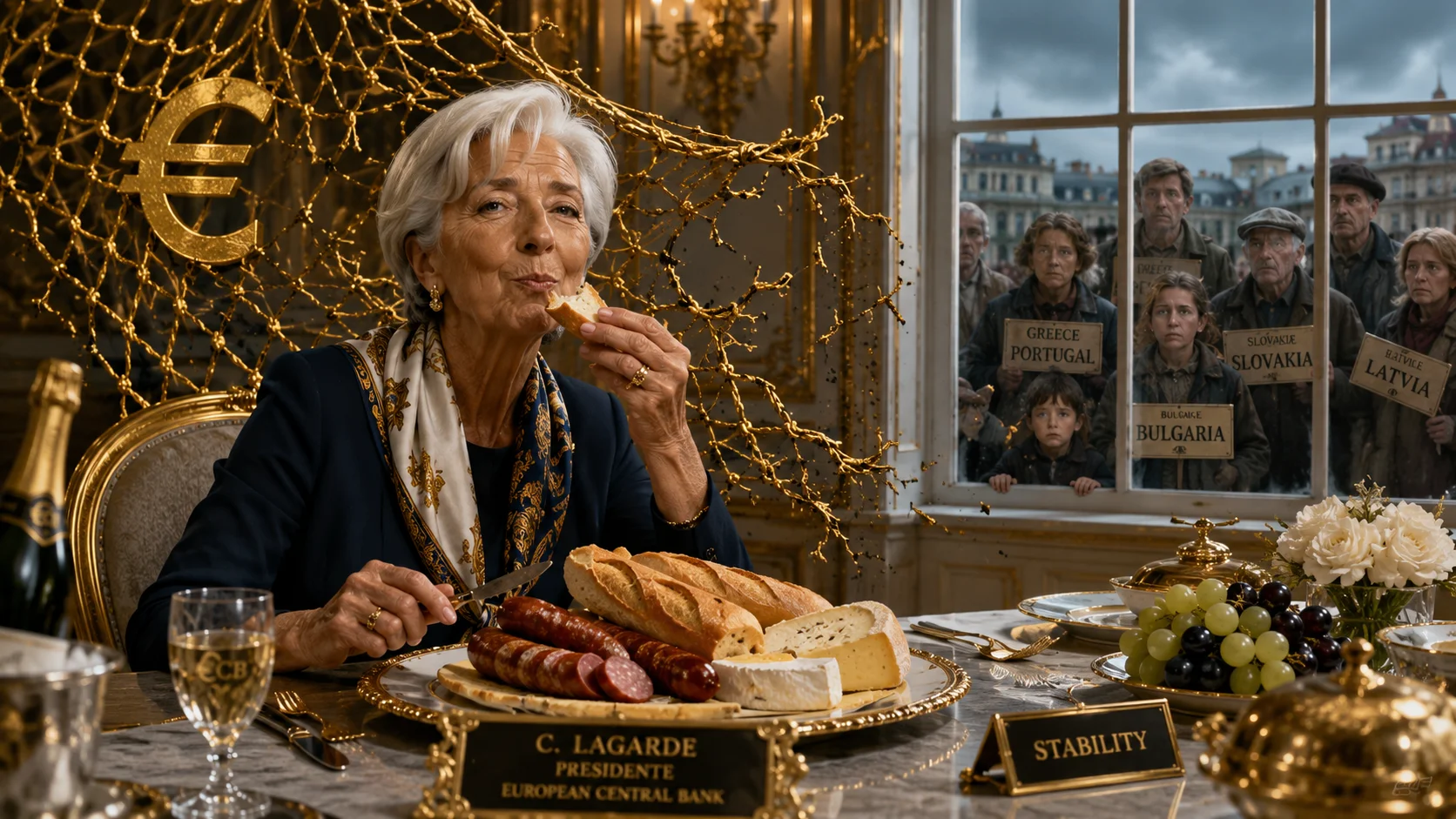
In a recent interview with Les Échos, European Central Bank President Christine Lagarde said she wants to make sure “a European voice must be heard in the French presidential debate.”
She added that she would speak with “a French and a European voice” and that France should play a “decisive role in the economic future of our continent.”
Sounds noble. Why maintain two or more separate voices when one French voice can simply be labelled European at no additional cost?
It comes at a time when the European Central Bank she leads is sitting on losses from the big bond-buying years, and the whole system is leaning more and more on one comforting object: gold.
Lagarde is no stranger to controversy. As French Finance Minister she was involved in the Tapie affair, where she was later found guilty of negligence for helping a wealthy businessman. Later, as head of the IMF, she played a central role in the Greek bailout policies.
Her current term as ECB President runs until October 2027, though she has not ruled out leaving earlier to take part in the French presidential debate.
The names currently being discussed are François Villeroy de Galhau, head of the French central bank, is seen as the French pick. Joachim Nagel, head of the Bundesbank, is the German candidate. Klaas Knot, former Dutch central bank chief, is also mentioned.
The golden safety net
For years the ECB bought enormous amounts of government bonds.
When interest rates were very low, this looked like a smart way to support the economy.
Later, when rates went up, the ECB started paying much higher interest on the money banks keep with it, while still holding those older, low-yielding bonds. The result: losses.
The ECB reported a €1.254 billion loss for 2025, after a much bigger €7.944 billion loss in 2024, and said its net equity rose mainly because revaluation accounts increased after the euro price of gold went up.
Fortunately, the ECB and several national central banks have a way to make the balance sheet look better.
They value their gold at today’s market price.
When gold goes up, the extra value goes into special accounts called gold revaluation accounts, acting like a cushion. They don’t fix the underlying problem, but they make the numbers look less bad on paper.
It is not illegal. It is allowed under the rules.
If gold stops rising or falls, the cushion becomes thinner. At that point, someone may have to explain why a continent of 450 million people, dozens of institutions and 900 panels on resilience is suddenly very emotionally attached to bullion.
Meanwhile, the EIB keeps lending
At the same time, the European Investment Bank has been lending very large amounts of money into projects that fit current political priorities - especially green transition and so-called strategic investments.
These projects are always described with the correct vocabulary. Green. Digital. Sustainable. Resilient. Inclusive. Strategic. Future-facing. Climate-aligned. Socially transformative. By the time the sentence ends, nobody remembers what is actually being built.
Many of these projects are chosen more for political reasons than because they are clearly profitable or necessary.
The European Parliament’s own briefing says the EIB Group reached a record €100 billion in new financing in 2025, with around 60% going toward green projects, and its 2026 planning includes €53.5 billion for climate, €23.5 billion for TechEU, €4.5 billion for security and defence, and €9 billion outside the EU.
If some of these investments perform badly, the losses do not stay inside the EIB.
They can eventually reach the member states that own it. So while one part of the EU system is quietly depending on gold prices, another part is pushing big spending based on political fashion.
When private investors are nervous, public money becomes brave. When public money is nervous, guarantees become innovative. When guarantees become inconvenient, the bill becomes European.
And when the bill becomes European, smaller countries should start checking their pockets.
France and Germany will still decide
When Lagarde’s term ends, or if she leaves earlier, the next ECB president will not be chosen through some open contest of ideas, competence, and democratic legitimacy. Let us not become hysterical.
The job will be decided through the traditional European method: several important people from France and Germany having dinner until the smaller countries are told what consensus looks like.
Smaller and weaker member states have almost no real influence on who gets the position. Yet these are often the countries that feel the effects of ECB decisions most strongly - higher borrowing costs, tighter conditions, or slower growth.
We have seen this before
During the Greek debt crisis, the official story was that Europe had to save Greece and protect the euro.
In reality, a large part of the effort went into protecting banks in France and Germany that had lent heavily to Greece and other southern countries. Greek citizens paid with years of austerity, pension cuts, collapsed living standards, and unemployment
When problems appear at European level, the decisions are heavily influenced by the strongest countries and biggest financial interests. The costs have a tendency to land more heavily on the weaker ones.
A French voice in a European debate
Lagarde presents her possible involvement in French politics as a way to defend Europe. She wants to speak with both a French and a European voice. The problem is that these voices are supposed to be distinct.
France wants its place protected. Germany wants its guarantees protected. Brussels wants its projects protected. Banks want their balance sheets protected. The Green Deal wants another funding line protected. Everyone wants protection.
The smaller countries are asked to protect Europe by accepting the consequences.
This is how European responsibility often works. Influence travels north and west.
Disciplinary measures travel south and east.
The Digital Euro
On top of everything, Brussels is still pushing the digital euro. This would give the ECB even more direct control over money while further weakening traditional banks. When the next crisis comes, it might not just be about who pays - it could also be about who controls how the money can actually be used.
In a crisis the ECB could more easily impose negative interest rates or even restrict withdrawals (“programmable money” fears).
~~
In a serious crisis, several things could go wrong at the same time.
The most immediate risk is another sovereign spread panic. Markets could start treating debt from Italy, Greece, Spain or other countries as much riskier again. Borrowing costs would rise sharply.
The ECB would then face a difficult choice: defend its inflation targets or step in to prevent countries from being crushed by their own borrowing costs. At the same time, the gold revaluation cushion that has been helping the balance sheet look better would offer less protection if losses keep growing.
Another risk comes from the EIB’s political lending.
A large number of projects that were approved mainly for political reasons could underperform. The EIB itself would not collapse, but the losses would eventually reach the member states that own it. When that happens, the bill stops being “European” and starts being national.
Then there is the Greek template.
In 2010, French and German banks were heavily exposed, and bailout design was deeply shaped by fear of contagion through the European banking system.
One European Parliament paper from the time noted French bank claims on Greece near $80 billion and German claims around $45 billion. That does not mean Greece was innocent or perfectly managed. But it does mean the “saving Greece” story also functioned as “saving creditors who had made very profitable mistakes.”
Finally, there is the small-country payment counter.
In almost every serious crisis, the same pattern appears. France wants Europe protected. Germany wants discipline protected. Brussels wants its projects protected. Banks want their balance sheets protected. The EIB wants its investments protected. Then the smaller and weaker countries are asked to protect everything by accepting higher costs, slower growth, or direct contributions.
~~
At the moment, the euro is not collapsing. The ECB reference rate was €1 = $1.1448 on 3 July 2026, so this is not currently a parity panic story.
Still, the Commission recently projected eurozone growth slowing to 0.9% in 2026, inflation rising to 3.0%, and deficits worsening, with an adverse energy scenario potentially halving growth.
Non-euro EU countries - Poland, Sweden, Czechia, Hungary, Romania and Denmark can laugh from the balcony during some eurozone drama, but they are still inside the building when Brussels starts passing around the EIB hat.
The countries outside the euro may still be trapped in the EU machine. But at least they kept the emergency exit marked “national currency.” The eurozone’s smaller members, meanwhile, get a seat at the table, a flag on the wall, and, when the music stops, a very European invoice.
Sources
You might also like