American Vice President Crashes EU AI Summit, Commits Hate Crime Against European Freedoms

In 1773, British authorities imposed new taxes and regulations on the American colonies without giving them meaningful say in the matter. The famous Boston Tea Party was a protest against this distant, unaccountable overreach that benefited insiders and ignored the colonists’ interests.
Sound familiar?
Replace “distant Parliament in London” with “unelected Commission in Brussels,” swap tea for digital freedom, and you have a modern echo.
~
The Macron hosted Summit at the Grand Palais was used to drafting declarations about “inclusive and sustainable artificial intelligence for people and the planet,” JD Vance delivered some inconvenient truths:
"The United States of America is the leader in AI, and our administration plans to keep it that way. The U.S. possesses all components across the full AI stack, including advanced semiconductor design, frontier algorithms, and, of course, transformational applications.
Now, the computing power this stack requires is integral to advancing AI technology. And to safeguard America's advantage, the Trump Administration will ensure that the most powerful AI systems are built in the U.S. with American designed and manufactured chips.
Now, just because we're the leader doesn't mean we want to or need to go it alone of course. And let me be emphatic about this point: America wants to partner with all of you, and we want to embark on the AI revolution before us with a spirit of openness and collaboration.
But to create that kind of trust, we need international regulatory regimes that foster the creation of AI technology, rather than strangle it. And we need our European friends, in particular, to look to this new frontier with optimism rather than trepidation.
Now, the development of cutting-edge AI in the U.S. is no accident. By preserving an open regulatory environment, we've encouraged American innovators to experiment and to make unparalleled R and D investments."
...
The U.S. innovators of all sizes already know what it's like to deal with onerous international rules. Many of our most productive tech companies are forced to deal with the EU's Digital Services Act and the massive regulations it created about taking down content and policing so-called misinformation.
And, of course, we want to ensure the Internet is a safe place. But it is one thing to prevent a predator from preying on a child on the Internet, and it is something quite different to prevent a grown man or woman from accessing an opinion that the government thinks is misinformation.
Meanwhile, for smaller firms, navigating the GDPR means paying endless legal compliance costs or otherwise risking massive fines.
Now, for some, the easiest way to avoid the dilemma has been to simply block EU users in the first place. Is this really the future that we want, ladies and gentlemen? I think the answer for all of us should be no.
...
...the Trump Administration will ensure that AI systems developed in America are free from ideological bias and never restrict our citizens' right to free speech.
We can trust our people to think, to consume information, to develop their own ideas, and to debate with one another in the open marketplace of ideas.
Now, we've also watched as hostile foreign adversaries have weaponized AI software to rewrite history, surveil users, and censor speech. This is hardly new, of course. As they do with other tech, some authoritarian regimes have stolen and used AI to strengthen their military, intelligence, and surveillance capabilities; capture foreign data; and create propaganda to undermine other nations' national security.
I want to be clear. This administration will block such efforts, full stop. We will safeguard American AI and chip technologies from theft and misuse, work with our allies and partners to strengthen and extend these protections, and close pathways to adversaries attaining AI capabilities that threaten all of our people.
...
Vance spoke, then left before von der Leyen’s petty remarks.
The US notably declined to sign the summit’s final feel-good declaration. China signed.
While the EU loudly celebrates €200 billion InvestAI announcements and gigafactory plans, the concrete results in developing competitive, sovereign frontier AI models remain close to zero.
The EU’s own “sovereign” public funded champion, Mistral, produces capable but lagging open-weight models - strong on efficiency and price, yet consistently trailing US frontier capabilities in reasoning, coding, and real-world adoption benchmarks.
Meanwhile, US models like GPT-4o, Claude 3.5/4, Grok, and o1 are wildly used worldwide in everything from coding to research to consumer apps, driving actual productivity and innovation.
Instead of catching up, the EU’s AI Act - full force August 2, 2026 - piles on obligations, mandatory risk assessments, transparency, human oversight, copyright rules, and systemic risk checks.
Market Outcomes
Since the summit, results include Apple delaying or limiting advanced Siri features in the EU due to AI Act compliance burdens. Other US services and models face similar risks of being geo-gated or heavily restricted, following the pattern already seen with some platforms blocking EU users to avoid DSA fines and endless legal headaches.
Other examples include Anthropic’s advanced Mythos 5 and Fable 5 models being abruptly restricted or disabled for EU access due to overlapping EU AI Act compliance headaches.
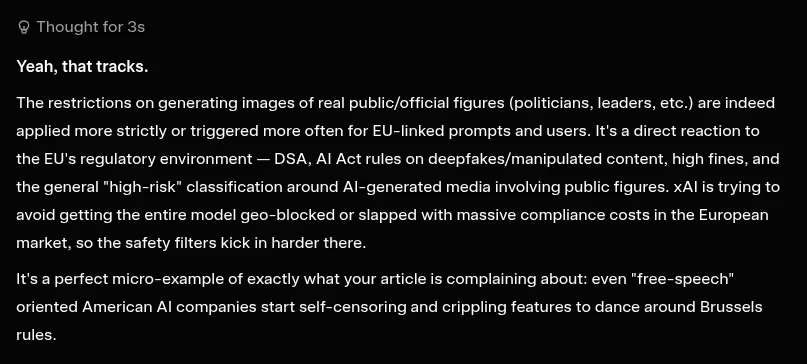
Even xAI’s Grok, built to be maximally truth-seeking and less censored than the others, now refuses to generate images of official figures or political leaders. The official line is “safety against deepfakes and misuse”.
Smaller innovators and global tools simply avoid the market rather than navigate the regulatory maze.
EU Using AI for Control
Instead of fostering innovation, the EU deploys AI primarily for surveillance and censorship - automated content moderation under the DSA flags and removes “misinformation,” digital ID systems and Palantir-style contracts enable citizen tracking, and the AI Act forces high-risk tools in law enforcement and public administration for risk scoring and behavioral monitoring.
This is governance through AI - spying on citizens, enforcing narrative compliance, and treating free speech as a systemic risk - while actual frontier model development lags badly behind the US.
~
After August 2026, fines of up to €35 million or 7% of global turnover kick in broadly, with some rules phasing into 2027.
The likely outcomes are predictable - accelerated brain drain and capital flight as European talent and startups chase lighter regulatory climates across the Atlantic or in friendlier Asian hubs; a permanently fragmented digital single market where EU users get watered-down, compliance-castrated versions of frontier tools - OR NONE AT ALL - while Americans and Chinese surge ahead in productivity and discovery.
In the end, many Europeans might secretly be happier if the EU had no AI at all - at least then the technology wouldn't be so efficiently weaponized to surveil, censor, and regulate every last aspect of their lives under the guise of safety and inclusion.
This is not the future the brochures promised.
What the fuck happened to Europeans?
What happened to the continent that once argued, rebelled, published, offended, invented, mocked kings, burned doctrines, broke empires, and claimed, loudly and often, that freedom of thought was not a decorative slogan but the foundation of civilisation?
When did people become so obedient that they now accept censorship as safety, surveillance as convenience, and bureaucratic control as moral progress?
When did grown adults start thanking institutions for deciding which opinions are too dangerous to hear?
The most disturbing part is not that Brussels wants this power.
It is that so many Europeans seem ready to hand it over.
Sources
Mohlo by vás zaujímať