Congratulations to Moderna on Its $44 Billion Cancer Vaccine Press Release

Moderna’s experimental cancer vaccine produced an extraordinary result.
Before the medical community had seen the Phase 3 efficacy numbers, it successfully treated Moderna’s share price.
Shares rose 177 percent in a single trading session, closing at $174.38 and adding roughly $44 billion to the company’s market capitalization. Moderna finished the day worth about $69.6 billion. Merck rose 12.6 percent as well.
This was an impressive response to an equally impressive scientific announcement.
Moderna and Merck said their Phase 3 INTerpath-001 trial had met its primary endpoint of recurrence-free survival and a key secondary endpoint of distant metastasis-free survival. The companies described the improvements as “statistically significant and clinically meaningful” and called the results a landmark for personalized cancer treatment.
There was only one minor administrative detail.
They did not release any efficacy numbers.
Intismeran autogene, previously called mRNA-4157 or V940, is individually manufactured for each cancer patient. A sample of the patient’s tumor is sequenced, mutations specific to that cancer are identified, and a synthetic mRNA therapy encoding as many as 34 selected neoantigens is produced. The idea is to teach the patient’s immune system to recognize cells carrying those mutations.
It is given alongside Merck’s Keytruda, or pembrolizumab, an established PD-1 immunotherapy.
It is also worth noting how the trial was designed. Only patients who were already cancer-free after surgery were allowed in. The treatment was being tested to see if it could stop the cancer from coming back later. One of the main endpoints, “distant metastasis-free survival,” combines two different things - the cancer spreading to distant organs and death from any cause - into a single measure, which makes the result harder to interpret.
The Phase 3 announcement provided even less quantitative information than the Phase 2 papers.
The missing data from Phase 3 might be close to the results seen in Phase 2.
The earlier Phase 2 trial (KEYNOTE-942) enrolled 157 patients, with a median age of 63, all of whom had already had their high-risk melanoma completely removed by surgery. At that point they also had no detectable cancer left.
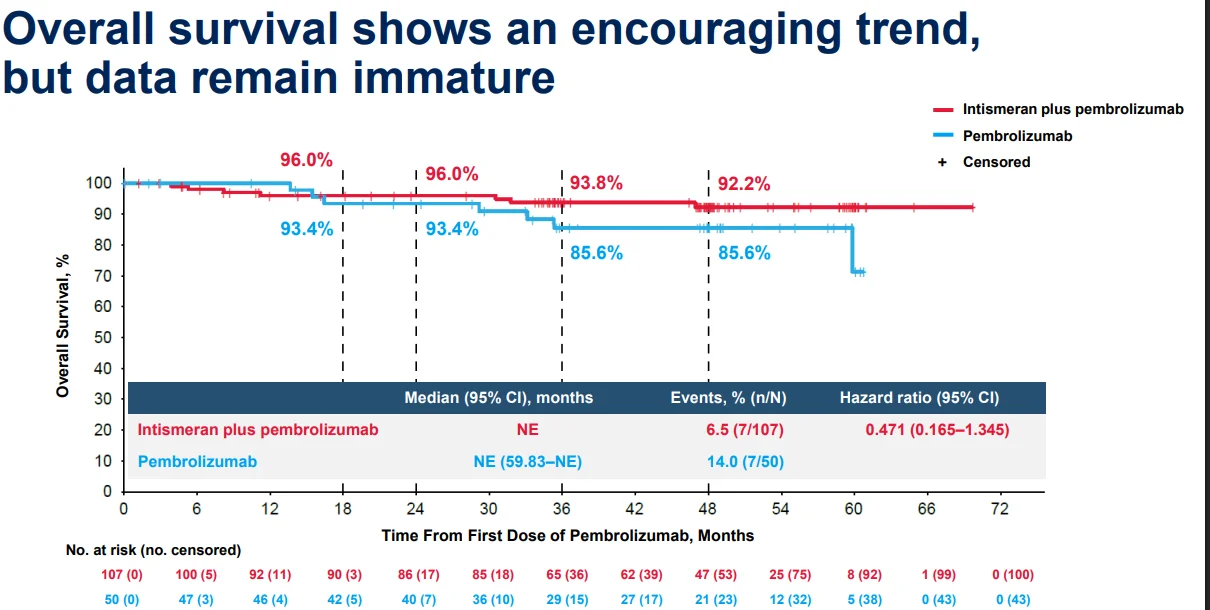
Across the whole study only nine patients died in the earlier analysis - four in the vaccine group (out of 107) and five in the Keytruda-only group (out of 50). By the five-year update the total number of deaths had risen only to 14.
The resulting hazard ratio was 0.425, which appears favorable until the confidence interval is examined: 0.114 to 1.584. The interval is so wide that it easily includes the possibility of no real difference.
The companies still described it as an “encouraging trend.”
The 1,137 patients in INTerpath-001 had stage IIB to IV melanoma that had already been completely surgically removed. They were then randomized to receive either intismera+Keytruda or Keytruda alone as adjuvant therapy, intended to reduce the risk that microscopic remaining disease would eventually cause the cancer to return.
Moderna entered this moment in a difficult financial position.
After the peak of COVID vaccine sales, revenue collapsed. The company posted multi-billion-dollar annual losses, cut research spending, reduced headcount, and arranged additional credit facilities to maintain flexibility. Cash reserves have been declining as the company continues to fund its pipeline.
Whether the detailed results will support the current valuation is a question that can only be answered when the numbers are finally released. Until then, the easy money has already been made by those who held the stock beforehand.
The good window to invest was yesterday.
You might also like