Pfizer’s New Invention: The Schrödinger’s Control Group and Other Tales
Flawless by Design
The pivotal trial reported 95 percent efficacy against symptomatic COVID-19.
Governments bought it by the billion. The public was introduced to mRNA, lipid nanoparticles and the wonders of twenty-first-century molecular biology.
Naturally, something this sophisticated had also been designed, manufactured and tested flawlessly.
Of course, the payload stays politely where intended, disappears on schedule and cannot possibly find its way backwards from RNA towards DNA.
Questions involving biodistribution, reverse transcription, LNP zeta potential or PEG/LNP hypersensitivity are apparently fairy tales rather than existing branches of molecular biology.
Process 2 was sufficiently comparable to Process 1 for authorisation according to the FDA, Health Canada and the EMA.
(Reverse transcription does, inconveniently, exist. BNT162b2-derived DNA has even been reported after exposure of human liver cells in vitro, but we don't want to bore the reader with facts.)
The Trial
The famous December 2020 paper had 43,548 randomized participants (EUA followed).
By the time Pfizer published its final Plain Language Study Results Summary in 2023, 46,406 people had started Phase 2/3, of whom 46,297 received a study vaccine.
ClinicalTrials.gov now lists 46,969 as the actual enrollment for C4591001 overall, with the completed record last updated on March 25, 2026.
In 2023, Pfizer does separately say 1,156 participants left Phase 2/3 during the blinded portion, most commonly because they could not be reached for follow-up.
This gap remains unreconciled in Pfizer’s 2023 plain-language summary - 23,141 placebo starters versus 21,371 placebo starters who later received BNT162b2. That leaves 1,770 people not represented in the crossover denominator and is not reconciled by the the 1,156 above, because those cover both randomized arms, not merely placebo recipients, and only covers departure during the blinded period.
By March 13, 2021, 19,525 original placebo participants had already been unblinded and given BNT162b2. Another 839 original placebo recipients had either chosen not to receive it or had not yet had the opportunity.
What Pfizer's final plain-language mortality section does not give us is one convenient bridge showing exactly how 23,141 original placebo recipients became 21,371 crossover recipients by the end.
So the placebo group remained in the dataset as the group that “got placebo at the start” with most of its members vaccinated.
The control group therefore occupied the peculiar scientific state of being both a control group and not a control group, depending entirely upon which column you happened to be reading.
The study continued following participants. But as a long-term randomized unvaccinated comparison group, the original placebo arm was progressively dismantled and dropped from the comparison.
HERE OUR NUMBERS IN GOOGLE SHEETS
The Deaths
That gets us into the lovely evolution from 2 vaccine deaths versus 4 placebo deaths at the November 2020 cutoff,
to 15 versus 14 during the blinded period by March 2021 (FDA),
and finally Pfizer's much stranger-looking 2023 presentation of 85, 62 and 23 deaths across overlapping exposure groups.
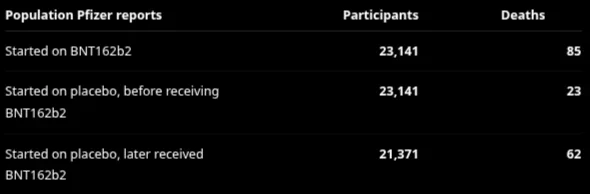
23 + 62 = 85.
Perfectly balanced.
At least until you ask what the groups actually mean.
Pfizer’s 85 deaths are among the 23,141 participants who received BNT162b2 at the start of the study. Those people were vaccinated from the beginning and Pfizer says their follow-up after BNT162b2 was about 18 to 24 months.
The 62 are among former placebo recipients who later received BNT162b2, and Pfizer says their post-BNT162b2 follow-up was also about 18 to 24 months.
The 23 occurred among the original placebo population before they received any BNT162b2.
We absolutely cannot turn that into “147 vaccinated versus 23 unvaccinated” either, because the denominators, person-time, crossover selection and lengths of observation are radically different. Pfizer itself says the placebo period was much shorter, with most placebo recipients unblinded around four to six months after Dose 2.
~~~
The later variant-adapted vaccines present another problem.
A vaccine designed around Omicron does not require two ancestral-strain injections before its mRNA can function.
The later trials largely asked what happened when the new dose was given to people who had already received the original vaccine.
It cannot tell us, from the same experiment, how that formulation would have performed as a first exposure in unvaccinated people.
By 2023 the FDA simply authorized bivalent vaccines for all doses, while noting that almost everybody already possessed antibodies from vaccination or infection.
The control group had, by now, vanished thoroughly.
Muddy Waters
And that leaves one final question.
By the end of the study, many participants who had originally received placebo had crossed over to BNT162b2. Many who had received the original two-dose series later received a third dose, additional boosters, or entered further study groups. Participants were followed for different lengths of time, under different exposure histories, while the original randomized comparison gradually dissolved.
So how many of the people who entered C4591001 can we actually identify, years later, as having received only the original two doses and nothing more?
And how many can we identify as having remained completely unvaccinated for a comparable period?
From the published aggregate numbers, we cannot.
Which leaves a rather simple question hanging over the long-term results:
What exactly are we comparing anymore?
Sources
You might also like