Australia Running Out Of Space – Legalises Human Composting
What a glorious leap forward - environmentally superior to those dirty old cremations with their nasty CO₂ emissions, a blessed relief from those ever-rising cemetery costs, and the perfect solution to our tragically limited burial space.
Finally, Australia can breathe easy as it embraces this sustainable, forward-thinking masterpiece of modern deathcare!
This comes from a country that still has enough empty land to hide several small European nations without anyone noticing, but of course, progress is progress.
How does this work?
Bodies would be turned into nutrient-rich soil that can be used in gardens or agriculture, undergoing natural organic reduction where the remains are mixed with bulking agents such as wood chips and straw, inoculated with thermophilic microbes, and subjected to a controlled aerobic composting process. Sustained temperatures above 55–70°C (131–158°F) drive thermophilic decomposition, breaking down tissues into stable, nutrient-rich humus suitable for gardens or agriculture.
Proponents promise the resulting compost is safe, pathogen-reduced, and odour-free after lab verification for indicators like Salmonella and E. coli.
Sadly, history shows compost and human waste have a habit of sharing similar microbial guests.
The process supposedly achieves significant pathogen reduction through prolonged high-heat phases, but history with compost piles, biosolids, and human waste shows that microbial guests can be remarkably persistent if temperatures fluctuate, aeration is uneven, or scaling introduces variability.
Of course, the tests exclude certain resilient customers like prions (e.g. Creutzfeldt-Jakob disease, the human equivalent of mad cow disease).
These misfolded proteins are highly resistant to standard inactivation methods.
Prions withstand typical composting temperatures of 55–70°C with little to no degradation. Reliable destruction generally requires extreme conditions such as incineration at temperatures exceeding 1200°C, prolonged autoclaving under high pressure, or specific chemical treatments combined with heat.
As a result, standard composting protocols cannot guarantee prion inactivation.
In the 1973 dystopian sci-fi film Soylent Green, a massively overpopulated, resource-starved future society discovers that the ubiquitous green wafer food product "Soylent Green" is secretly manufactured from the processed remains of euthanized citizens.
But we are yet far from that, experts say.
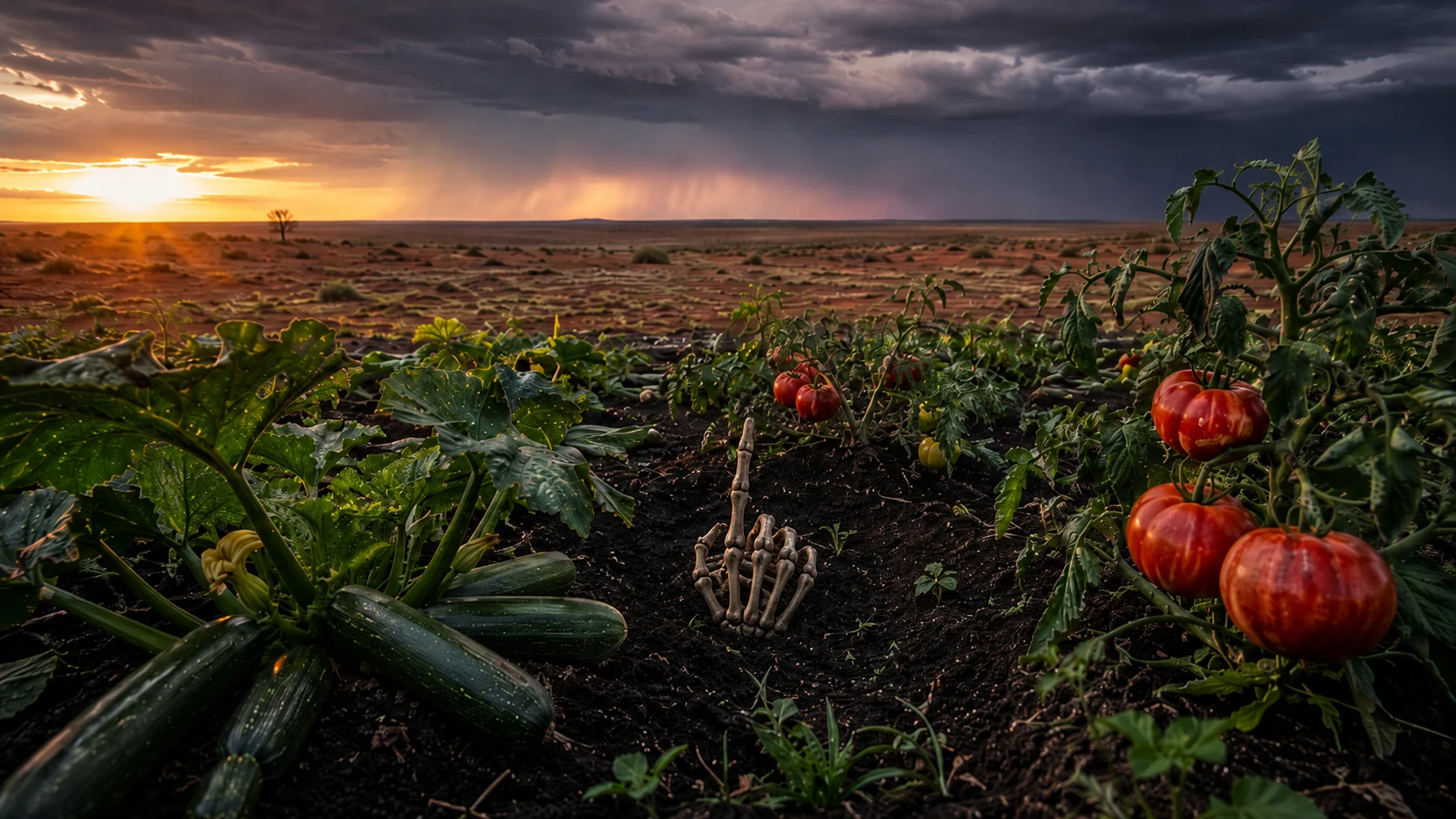
Check your tomatoes twice.
And so, as the final curtain falls on yet another triumph of enlightened governance, Australians can rest assured, that their dearly departed are no longer a burden on the earth, but a bountiful gift to it.
Truly, what better way to close the circle of life than turning Uncle Barry into prize-winning zucchinis?
Soylent Soil™ - Canada and Europe can't wait to get in on the action.
Mohlo by vás zaujímať