Brussels Solves Breakfast: Coffee Optional, Cabbage Compulsory
The residue rules
Under the Food and Feed Safety Simplification Package adopted in December 2025, the Commission is laying the groundwork to lower maximum residue levels of certain hazardous pesticides that are already banned for use inside the EU.
The target is the limit of quantification - effectively “technical zero.” The stated aim is to stop substances prohibited in the Union from re-entering through imported food and feed.
A preliminary study by the Commission’s own Joint Research Centre examined what would happen if this approach were applied to the most hazardous non-approved substances.
- In the worst-case scenario, where producers outside the EU do not change their practices, the effects are stark: Agricultural imports could fall by around 41 percent.
- Coffee prices could rise by 332 percent - or the product could simply become unavailable in many places.
- Citrus fruit could increase by 82 percent.
- Soybean meal, a major protein component in animal feed, could rise by 105 percent.
Soybean meal forms a large share of the feed ration for poultry and pigs. Feed already accounts for a substantial part of production costs in intensive livestock farming. A sharp increase therefore feeds directly into higher meat prices, particularly chicken and pork. Beef is less directly exposed but not immune.
The Commission insists that any actual changes will be made case by case after impact assessments, and that food security and international implications will be taken into account. The direction of travel, however, is clear.
Caffeine and its sources
Natural caffeine is produced by a small number of plants, none of which are native to Europe. The main sources are:
- Coffee (Coffea species) - tropical Africa and later the Americas and Asia
- Tea (Camellia sinensis) - East Asia
- Cacao (Theobroma cacao) - tropical Americas
- Yerba mate (Ilex paraguariensis) - South America
- Guarana (Paullinia cupana) - Amazon basin
- Kola nut (Cola species) - West Africa
- Yaupon holly (Ilex vomitoria) - southeastern North America
Europe has none of these in its traditional flora. When coffee or tea became scarce or expensive in the past, people turned to roasted chicory, dandelion root, barley or rye. These produce a bitter drink that looks the part but contains no caffeine. The continent’s historical answer to the need for a morning stimulant was either imported leaves and beans or simply doing without.
Coffee could be grown in a few sheltered microclimates in Southern Europe - notably parts of Sicily, the Canary Islands, and isolated spots on the Spanish mainland - but only in tiny experimental or boutique quantities. Outside these exceptional locations the climate remains too cool in winter or too dry in summer for reliable outdoor production. Any attempt at meaningful scale would require glasshouses, intensive climate control, shading systems or other costly protected-environment technology.
The European Union consumes roughly 2.5 to 3 million tonnes of coffee every year. Even under optimistic commercial yields of 1.5–2 tonnes of green coffee per hectare, covering that demand would require well over a million hectares of land - an area larger than many entire European regions. The handful of experimental plants currently producing a few dozen kilograms in Sicily or Spain are therefore irrelevant to actual supply.
EU also runs CIRCULANDIA, a Horizon Europe project devoted to regenerative agriculture, shorter supply chains, local food production and reusable packaging. The project is designed so that successful approaches can be expanded into wider European solutions.
Back to the regional kitchen
Fortunately the region already possesses a complete traditional kitchen that requires neither Brazilian soy nor Ethiopian coffee:
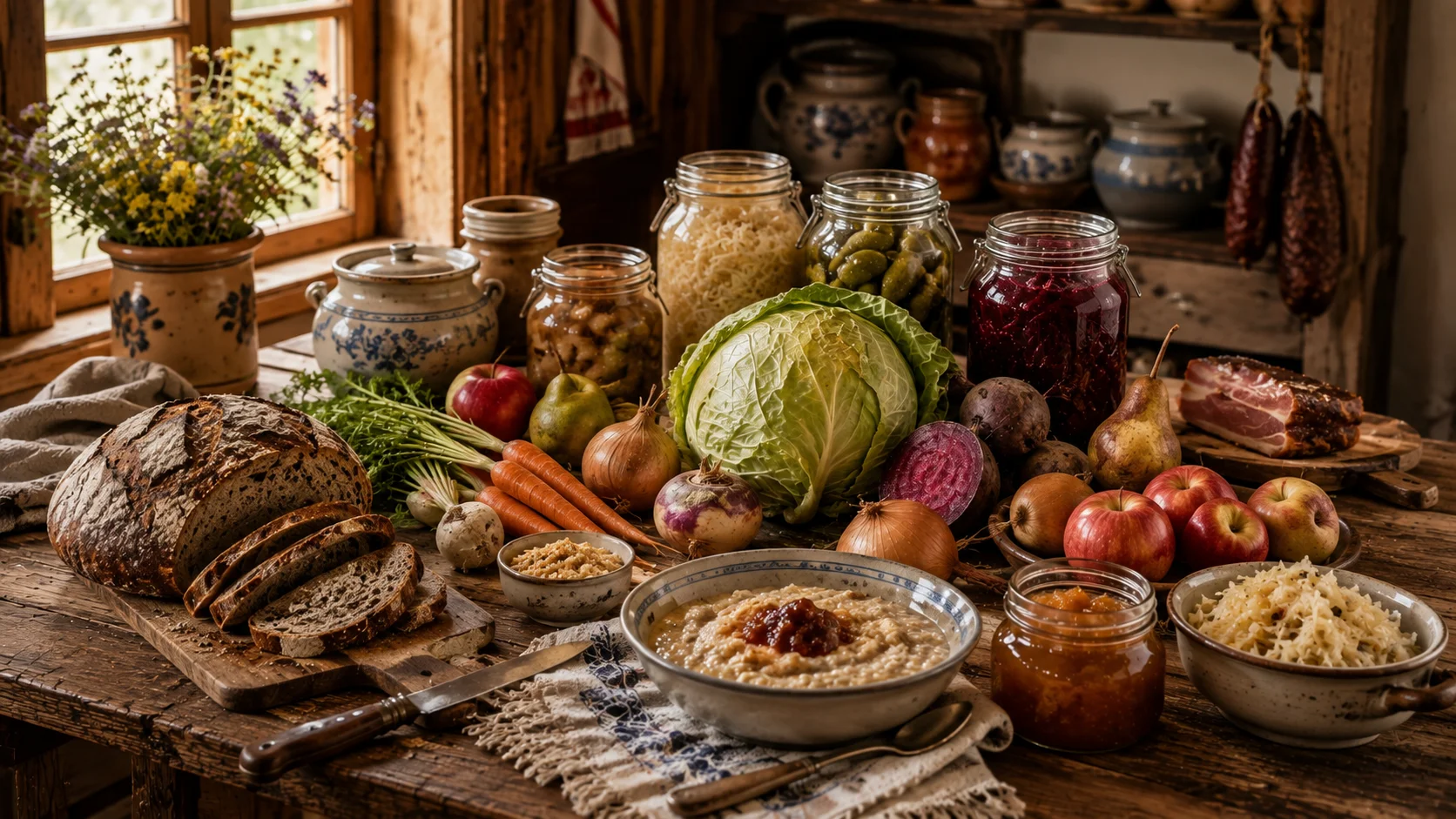
- Cabbage, fresh or fermented as sauerkraut.
- Beetroot, turnips, parsnips and carrots.
- Onions, leeks and garlic.
- Peas, beans and lentils.
- Barley, rye and oats.
- Apples and pears, fresh, dried or turned into cider and vinegar.
- Whatever could be salted, smoked or stored in a root cellar.
Northern France
Wheat and rye bread, thick vegetable pottages, cabbage, leeks, onions, peas and broad beans. Pork and poultry when available, cheese, and wine or cider. A common dish was a simple pottage of cabbage, leeks and dried peas simmered with a piece of salted pork or bacon, thickened with bread or oats, and eaten with coarse bread.
Northern Germany
Rye bread, barley or oat porridge, kale and white cabbage, root vegetables, salted or smoked fish and pork, and beer. Fermentation was essential. Sauerkraut (fermented white cabbage) was stored for winter and eaten with boiled pork or sausages. A basic daily meal was Grütze (barley or oat porridge) with a side of stewed cabbage and a piece of preserved meat.
Austria and the Alpine region
Similar foundations - cabbage, root vegetables, rye and barley - but with more dairy. Cheese, sour milk products and butter featured more prominently. Dumplings made from leftover bread or flour, stews of cabbage and smoked meat, and simple fruit preparations from apples and pears were common. A typical dish was a cabbage and smoked-pork stew thickened with bread or served with dense dumplings.
Eastern Slavic areas
Rye or mixed-grain bread, kasha (porridge from barley, buckwheat or millet), cabbage, beetroot, turnips, peas and beans. Fermented dairy (sour cream, soured milk) and preserved meats. Cabbage soup (kapustnica or similar) made with fermented cabbage, dried mushrooms, smoked meat and sometimes dried fruit was a winter staple. Simple boiled dumplings filled with cabbage or cheese, or thick vegetable and grain stews, formed the bulk of ordinary meals.
This was the everyday diet of the Middle Ages and early modern period across large parts of the continent - hardy, storable, local, and independent of global shipping. Fermentation and cellaring solved winter without the need for multi-million-euro research consortia.
Who needs Ethiopian coffee, Chinese tea or tropical chocolate when Germany has raw pork on a bread roll, Austria has dumplings dense enough to affect local gravity, and half of Eastern Europe has spent a thousand years discovering increasingly inventive things to do with cabbage?
Perhaps Brussels is simply helping Europeans reconnect with their roots - without asking them first.
Besides, a population running on cabbage and Grütze is far less likely to revolt.
Sources
Mohlo by vás zaujímať