EU Taxpayers Ecstatic: €11.1 Billion in Humanitarian Aid Swiftly Delivered to Authoritarian Playgrounds Since Von der Leyen Took Over

Brussels, 28 May 2026 - Since Ursula von der Leyen took office as Commission President in December 2019, the EU has poured €11.1 billion in humanitarian aid into authoritarian playgrounds and conflict zones abroad, while its own citizens hit by floods, wildfires and earthquakes inside the Union received less than one-third of that amount - just €4 billion - from the much smaller internal solidarity funds.
Analysis:
According to the official DG ECHO figures, the EU’s humanitarian aid budget has grown steadily under von der Leyen’s watch:
€900 million in 2020,
€1.4 billion in 2021,
€1.5 billion in 2022,
€1.7 billion in 2023,
€1.8 billion in 2024,
€1.9 billion in 2025,
and another €1.9 billion this year.
Total initial budgets 2020–2026: a cool €11.1 billion, with actual spending often ending up higher thanks to mid-year top-ups for emergencies – because the world just keeps needing more help.
Where is this generous outpouring going?
Straight to the world’s most desperate spots, of course.
The top recipients since 2020:
- Greater Horn of Africa (~€2.06 billion) – Ethiopia, Somalia, South Sudan and friends.
- West & Central Africa (~€1.6 billion+) – Sahel, Nigeria’s northwest, Lake Chad basin, CAR. Regions famous for their transparent governance and warm welcome to international donors.
- Syria + regional crisis (~€1.53 billion) – Governed by a former terrorist, calling Syrian migrants in the EU "strategical assets".
- Ukraine + Moldova (~€1.56 billion) – no comment.
- Afghanistan, Pakistan & Iran (~€1.14 billion) – let's support the Taliban and Mullahs
Rounding out the podium are Yemen (€783 million),
Palestine/Gaza-West Bank (€736 million), and the Great Lakes region including DRC (€550 million).
All of it delivered through NGOs, UN agencies and the Red Cross, with the EU insisting it’s strictly for civilians and never, ever touches the hands of those in power.
EU officials stress that every euro is allocated via annual Humanitarian Implementation Plans (HIPs) and guided by the principles of humanity, neutrality, impartiality and independence.
No favouritism, no politics – just pure, selfless generosity every one of us EU folks should praise.
~~
2026 figures
EU DG ECHO 2026 Humanitarian Aid Allocations (initial €1.9 billion budget, implemented via official Humanitarian Implementation Plans – HIPs, as of latest published data).
Country/region-specific breakdown (amounts in € million, from DG ECHO HIPs):
Largest recipients (by HIP envelope):
- Greater Horn of Africa (Ethiopia, Somalia, South Sudan, Kenya, Uganda, etc.): €377.5M
- West & Central Africa (Sahel, Nigeria NW, Lake Chad, CAR, etc.): €235M
- Syria regional + Lebanon crisis: €234.8M (Syria ~€210M, Lebanon ~€100M as per earlier confirmations)
- Ukraine + Moldova: €228M (Ukraine €145M initial + additional)
- Afghanistan, Pakistan & Iran: €126M
- Palestine (Gaza/West Bank): €124.4M
- Latin America & Caribbean: €95.3M
- Yemen: €85M
- Great Lakes (DRC, Burundi, etc.): €81.2M
- South, East & South-East Asia + Pacific (incl. Myanmar/Bangladesh): €74.9M
- Southern Africa & Indian Ocean: €36M
- North Africa: €22.6M
- Iraq: €12M
Other / global / strategic envelopes:
- ReliefEU (emergency response): €115M
- Strategic priorities & policy support: €84.9M
- Strategic humanitarian supply chain: €10M
- Regional Protect Aid Workers programme: €3.5M
- Turkey / South Caucasus / Central Asia / Western Balkans: €1M (separate Turkey top-up of €20M announced later)
Regional summary (matches the €1.9B initial map):
- Sub-Saharan Africa: €557M
- Middle East & North Africa: €463M
- Asia / Latin America / Pacific / Caribbean: €294M
- Ukraine / Western Balkans / Caucasus: €153M
- Non-geographical / flexible reserve (sudden emergencies): €415M
One can only wonder what Europe could have done with those same €11.1 billion if the money had actually been spent on Europeans: sealing borders, building proper border infrastructure, funding real internal security, or simply helping our own struggling families and pensioners instead of endlessly subsidising chaos abroad.
But no. Better to keep the cheques flowing to authoritarian regimes and conflict zones.
Is this the EU’s modern form of hostage money - expensive insurance payments so the trouble (and the migrant waves) stays far away from our shores (which they don't)?
What better way to spend €11.1 billion than ensuring that even in the toughest places, the aid keeps coming - no questions asked, no reforms demanded, just good old-fashioned European compassion.
At least we voted for this. Didn't we?
Sources: Official DG ECHO HIPs 2020–2026, Joint Communication on EU humanitarian action, 27 May 2026.
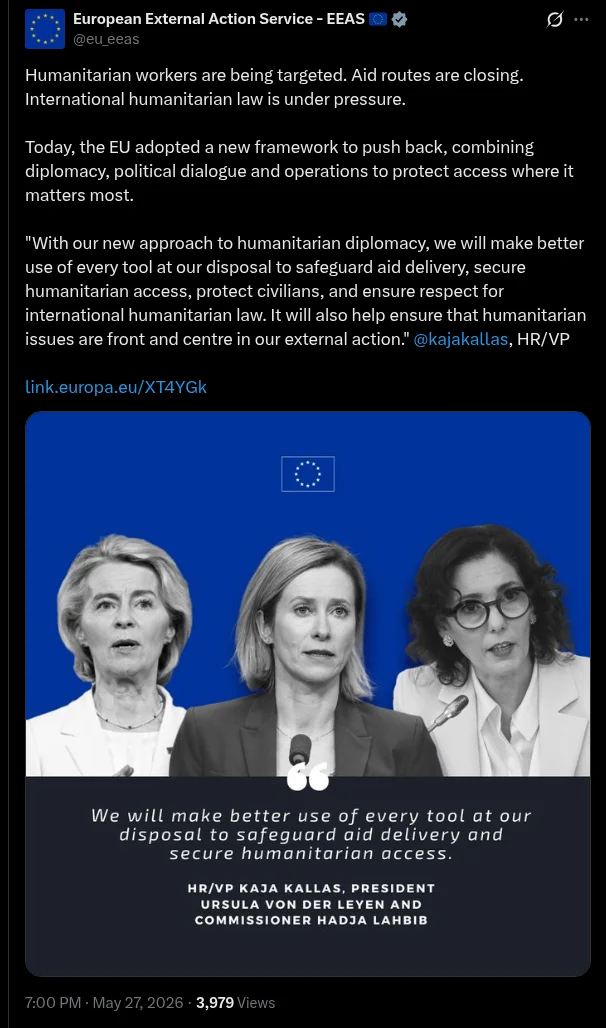
https://x.com/eu_eeas/status/2059666160849920237
US Taxpayers Can Be Happy Too: Trump Heavily Slashes the Foreign-Aid Nonsense
While EU taxpayers are still stuck with Von der Leyen’s €11.1 billion “humanitarian diplomacy” bonanza flowing straight into the usual authoritarian playgrounds, American taxpayers finally have something to smile about.
The blank-cheque era is over. Humanitarian aid has been slashed from $10–17 billion/year pre-Trump to roughly $3.7 billion in 2025 and $5.4–5.5 billion in 2026 (Congress bumped up Trump’s even lower request).
Here’s the dramatic before-and-after under Trump:
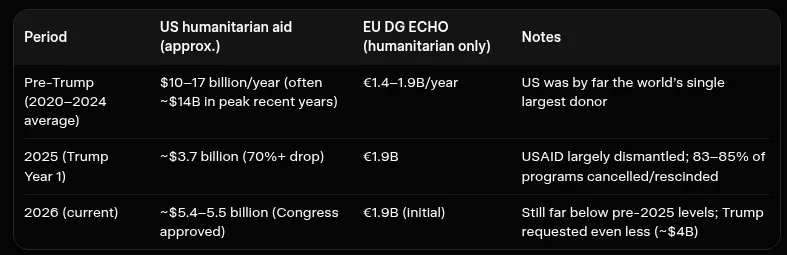
By July 2025, USAID as an independent agency effectively ceased to exist. Most staff were cut (94%+ reductions reported), and the vast majority of programs (83–85%) were terminated or transferred to the State Department.
The massive USAID overhaul, program terminations and “America First” reset actually delivered real savings - something EU taxpayers can only dream of right now.
Back to the EU: How Much Humanitarian Money Actually Went to Europeans? (Almost None)
€0 went to EU member states.
Zero. Zilch. Not a single euro of that budget is allowed to be spent on catastrophes inside the EU.
DG ECHO’s legal mandate is strictly for third countries - outside the Union.
So what does the EU actually spend on its own catastrophe victims?
It uses two completely separate instruments:
- EU Civil Protection Mechanism (UCPM + rescEU)
- Mostly in-kind help: firefighting planes, search-and-rescue teams, medical units, temporary shelters, etc., coordinated from other member states.
- The EU co-finances transport and logistics (usually 75 %).
- Budget is tiny compared to humanitarian aid - part of a €3.3 billion envelope over several years, shared between inside and outside the EU.
- European Union Solidarity Fund (EUSF) - the actual cash for reconstruction.
- Pays for emergency operations, cleaning up, restoring infrastructure, temporary housing, etc.
- Annual size: roughly €500–600 million + carry-overs (far smaller than the €1.9 billion annual DG ECHO budget).
The Ahr Valley flood (2021) - Germany’s worst recent catastrophe
After the devastating floods in the Ahr Valley (Rhineland-Palatinate) and neighbouring regions:
- Germany received €612.6 million from a bigger €718.5 million package approved in 2022 for seven EU countries hit by 2021 disasters (Germany got the lion’s share).
- Additional smaller EUSF payouts have gone to Germany for later floods (e.g. €112 million in 2024 for Bavaria/Baden-Württemberg).
Total paid out since 2020 (under von der Leyen): roughly €4 billion (for natural disasters + COVID emergency interventions).
Some of the bigger payouts since 2020:
- Croatia Zagreb earthquake (2020): ~€684 million
- 2021 floods package (including Germany’s Ahr Valley disaster): €718.5 million (Germany alone received €612.6 million)
- COVID-19 health emergency: several hundred million euros across multiple countries
- 2023 climate disasters (Slovenia, Greece etc.): >€404 million
- 2024 floods (Central Europe): €108 million (Austria/Poland) + €114 million (Czechia) + further packages
- Spain 2024 DANA storm/Valencia floods: €946 million (one of the largest single payouts ever)
- Smaller 2025 packages (wildfires, more floods): dozens of millions more
All of this is still dwarfed by the external humanitarian machine that keeps growing every year (€1.9 billion per year and rising).
Bottom line for EU taxpayers
While Brussels keeps writing ever-larger cheques to the usual suspects abroad with almost no conditions, the money available when your own citizens are hit by floods, wildfires or earthquakes remains a tiny, bureaucratic afterthought.
Priorities, right?
Sources
You might also like