Europe’s Most Successful Technology Business Is Fining Foreign Technology Businesses
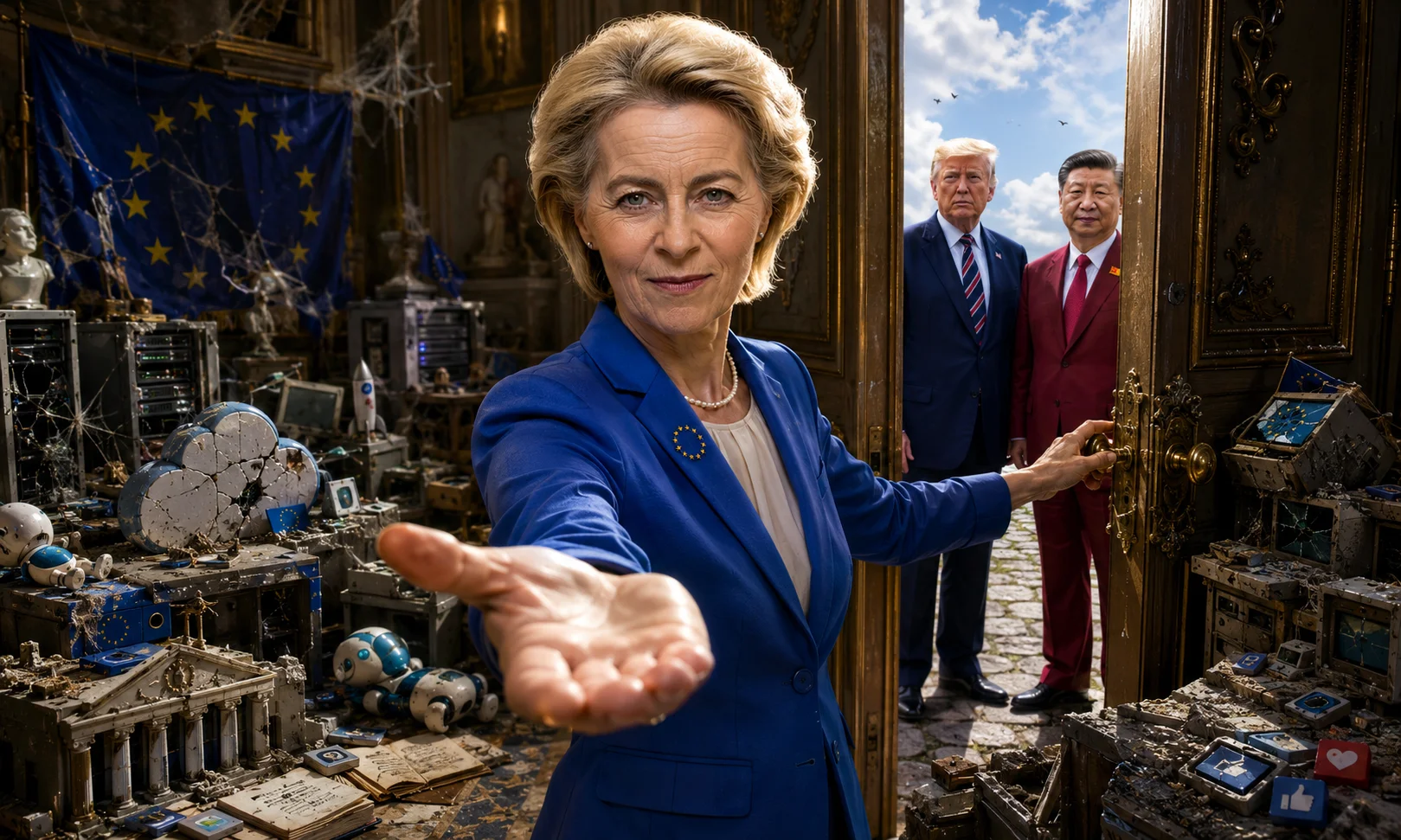
On 23 July 2026, the European Union unveiled its latest successful digital product: an invoice.
The European Commission fined Google a total of €890 million under the Digital Markets Act. €460 million for ranking its own services higher on Search. €430 million for making it harder for app developers to steer users away from Google Play toward cheaper alternatives.
This is not an isolated success.
Since Ursula von der Leyen took the lead, the overall fines of foreign tech companies climbed to €8.05 billion.
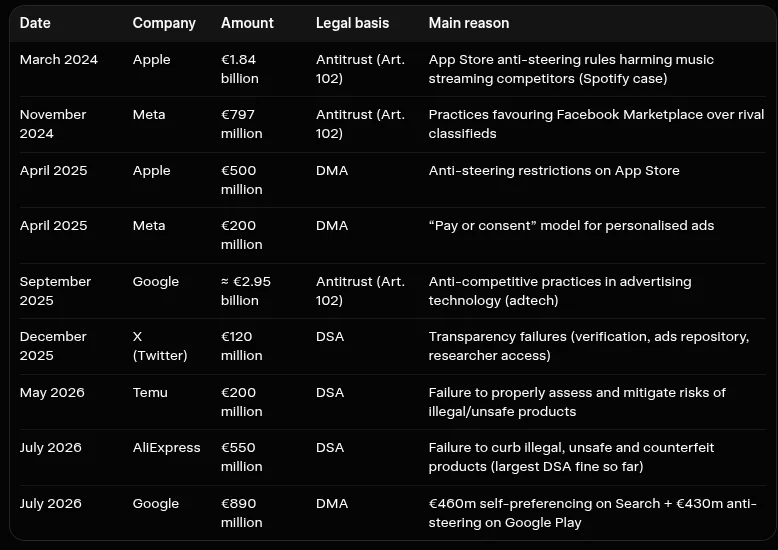
The pattern reveals an interesting fact.
The United States and China build the platforms. Europeans use the platforms. Brussels regulates the platforms and collects the fines.
Europe has finally found its place in the digital value chain.
The Money That Reduces a Bill Which Keeps Increasing
According to the Commission’s own rules, the fine "revenue" goes into the general EU budget and is supposed to reduce Member States’ contributions the following year.
In practice the overall budget keeps expanding.
In 2024, the EU budget contained €142.6 billion in payment appropriations. In 2025, payments rose to €155.2 billion. For 2026, they reached €190.1 billion. Meanwhile, the Commission has proposed a new seven-year budget for 2028 to 2034 worth almost €2 trillion.
New priorities appear every cycle: Ukraine Facility packages, multi-year support for the Palestinian Authority, civil-society grants, administrative costs, and the automatic salary adjustments that have pushed the Commission President’s basic pay from roughly €28,400 in 2020 to around €35,800 today, plus residence and other allowances.
The money collected through Commission fines is not paid directly to consumers who were harmed, handed to competing businesses or placed in a dedicated fund for building European technology companies.
The EU budget
Despite the ceremonial language of “own resources,” the EU does not independently earn most of its budget.
In the initial 2026 budget, €133.6 billion came from the GNI-based contribution,
€24.8 billion from the VAT-based contribution and
€6.8 billion from the plastics contribution, all ultimately supplied by Member States.
Excluding those transfers, Brussels expected approximately €21.4 billion in customs duties and
€3.5 billion from staff taxes, fines, interest, third-country programme contributions and refunds.
The EU’s independent income therefore covered only around 13 percent of the budget, and even part of that consisted of money recycled from its own payroll or recovered from governments and programmes.
Once fine revenue enters the general budget, it loses any meaningful connection to the company or violation that produced it. It becomes general revenue available to support the expenditure authorised in the EU budget.
Europe’s Successful Competitors Remain Theoretical
The Commission describes the Digital Markets Act as a way to make digital markets fairer and more contestable.
Meanwhile the same EU that fines foreign platforms for being too successful have spent years trying - and failing - to produce European replacements.
It is not that Google, Apple, Meta and the others pay no corporate tax in Europe. They do. The money, however, goes to the national budgets of Member States, not to the European Commission. For Brussels, that is a problem.
Mario Draghi’s competitiveness report stated that only four of the world’s fifty largest technology companies were European. It also found that Europe’s share of global technology revenue fell from 22 percent in 2013 to 18 percent in 2023, while the American share rose from 30 percent to 38 percent.
Three American hyperscalers accounted for more than 65 percent of both the global and European cloud markets, while the largest European cloud operator held only around 2 percent of the European market.
Google alone held approximately 88.6 percent of the European search-engine market in June 2026.
Europe has not been entirely inactive.
Quaero (2005–2013) - Franco-German publicly funded search-engine project. Absorbed hundreds of millions of euros. Quietly died. No lasting product.
Theseus (German counterpart to Quaero, same period) - Same fate. Research results, no consumer search engine that mattered.
Qwant (2015) -The European Investment Bank provided €25 million to the Franco-German search company to create a privacy-focused European alternative. Eleven years later, Qwant still exists, almost nobody uses it, and Google holds roughly 89 percent of the European search market.
Gaia-X (announced 2019) - Europe’s answer to dependence on American and Chinese cloud providers. It never became a European equivalent of AWS, Azure or Google Cloud. American hyperscalers joined the initiative. Europe’s cloud market remains dominated by the same three American companies.
Sovereign Cloud Stack (SCS) and related Gaia-X offshoots - Technical standards work continues, but they have not produced a cloud offering that seriously challenges the American hyperscalers.
EU Voice and EU Video (2022) - Launched by the European Data Protection Supervisor as decentralised social-media pilots based on Mastodon and PeerTube. Both services were closed on 18 May 2024 because no EU institution was prepared to maintain the servers.
OpenWebSearch.eu (2022–2025) - Funded with €8.5 million to build an open European web index. The index exists. No competitive European search product has emerged from it.
Peertube and various official/institutional Mastodon instances - Received public money and political praise as decentralised European alternatives. Remain niche with almost no mainstream adoption.
EuroStack (2024–2025) - Political branding exercise for a “European tech stack.” Still mostly papers, conferences and funding calls rather than working services people actually switch to.
European Digital Identity Wallets - By the end of 2026, Member States must offer wallets capable of proving identity and personal attributes. These are identity tools, not competing platforms.
EU age-verification application - Completed by the Commission. Can be activated with a passport or national ID card and is designed to disclose only an age threshold. Security researchers bypassed it in under two minutes. Its most immediate use is proving a European is old enough to enter an American or Chinese platform.
W (2026) - Swedish social network launched as a European alternative to X and enthusiastically joined by the European Commission and other EU institutions. To post or comment, users must install a separate identity app and scan a passport or national identity card. Pseudonyms are allowed only after official identity has first been established.
Facit - Every major European digital sovereignty project of the last decade has either collapsed, stagnated at irrelevant market share, or produced tools whose primary function is identity verification and compliance rather than services people actually choose to use.
Brussels has become exceptionally skilled at defining what technology companies must do.
It can determine how search results should be displayed, how application developers must be treated, how online marketplaces must assess risk, how platforms must moderate content, how advertising consent must be collected, how researchers receive data and how companies must document compliance with all of the above.
This produces regulations, supervisory bodies, reporting systems, investigations, workshops, consultations, enforcement decisions and fines.
Successful consumer platforms require speed, reliability, useful features, global scale, enormous infrastructure, developer support and enough users to make joining worthwhile.
Europe’s institutional instinct is different. It tends to begin with governance, compliance, certification, identity, oversight and political safeguards.
Thus, Europe remains dependent on foreign search engines, foreign mobile operating systems, foreign social networks and foreign cloud infrastructure.
But hey, there is a good ending to this Odyssey
Europe has discovered a reliable digital business model.
The platforms remain American and Chinese.
The users remain European.
The fines flow to the EU's "own" budget.
Europe’s most successful technology business is no longer technology.
It is accounts receivable.
Sources
You might also like