Moderna’s mRNA Flu Vaccine Enters Through the Retirement Home

The result is mFLUSIVA, the first FDA-approved mRNA vaccine for seasonal influenza. It is licensed for adults aged 50 and older, with traditional approval for ages 50 through 64 and accelerated approval for those 65 and above.
Moderna’s pivotal efficacy trial, P304, randomized 40,805 people aged 50 or older to receive either mRNA-1010 or a conventional standard-dose influenza vaccine. The mRNA product showed 26.6% relative vaccine efficacy compared with the conventional vaccine.
During the season, 2.0% in the Moderna group developed RT-PCR-confirmed protocol-defined influenza-like illness, compared with 557, 2.8%, in the conventional-vaccine group.
P304 did not include a saline-placebo arm or a deliberately unvaccinated control group, so we have no idea what percentage of the same population would have met exactly the same symptom criteria and tested positive for influenza after receiving nothing at all.
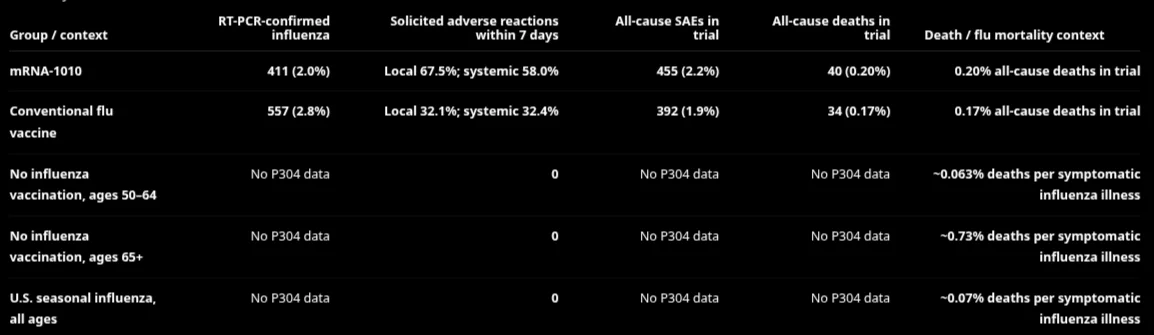
Investigators attributed serious adverse events to the study vaccine in four mRNA-1010 recipients and two conventional-vaccine recipients.. None of the deaths were judged vaccine-related.
The Convenient Age of 50
The P304 population had a median age of 64, with participants ranging from 50 to 97.
To avoid unfairly turning this into an actual nursing-home experiment, the FDA notes that most participants over 65 were considered fit rather than frail. The study did not record whether participants lived in nursing homes.
This would be considerably less interesting if Moderna had never tested mRNA-1010 in younger adults.
It had.
Earlier Phase 1, Phase 2 and Phase 3 studies included adults beginning at 18.
Study P301 alone randomized more than 6,000 adults aged 18 and older, while P303 included an adult 18-plus population and a separate 18-to-64 group.
Older people complain less.
This is not an interpretation smuggled in from Telegram by somebody whose profile picture is a tiger wearing sunglasses (you may find me on Discord).
Moderna said it itself.
In a 2023 presentation describing mRNA-1010, the company noted that reactogenicity in older adults was lower than in younger age groups.
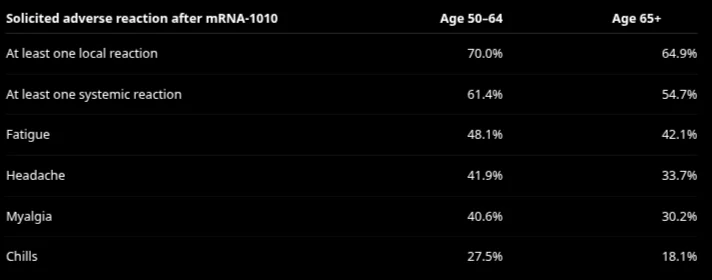
The older the participants became, the less enthusiastically their bodies appeared to object.
The FDA also found that solicited adverse reactions occurred more frequently with mRNA-1010 than with the conventional comparator across every subgroup it examined. The FDA nevertheless judged them acceptable.
In other words, Moderna developed a vaccine whose unpleasant short-term reactions were more frequent than those of the conventional alternative.
The Retirement Home As the Lobby
The 50-plus group is not the final frontier for mFLUSIVA.
Moderna plans to establish safety and effectiveness in adults aged 18 and older before enrolling infants, children and adolescents with studies extending through 2029, 2030 and 2031.
This makes the first approval rather easier to understand as a regulatory foothold.
The vaccine enters through a population at high risk from influenza, where the benefit case is strongest and reactogenicity is lower.
Once licensed there, the formal development pathway points downward through the age brackets.
~
For a healthy person, particularly at the younger end of the approved population, the first question should be whether pharmaceutical prevention is necessary at all. Influenza risk is not distributed evenly across the population. Age, frailty and underlying disease matter enormously.
The clinical trial begins after the decision to vaccinate has already been made, and even the conventional vaccine used as the comparator carries side effects of its own.
Which brings us to the question the trial never asked.
Perhaps we should start asking: Who needs an annual injection in the first place?
Save the gran, get vaccinated!
(haven't we heard that before)
Sources
Mohlo by vás zaujímať