Tedros Adhanom Ghebreyesus: The WHO Chief, Ethiopia’s Political Past, and the Genocide Allegations That Keep Circling Back
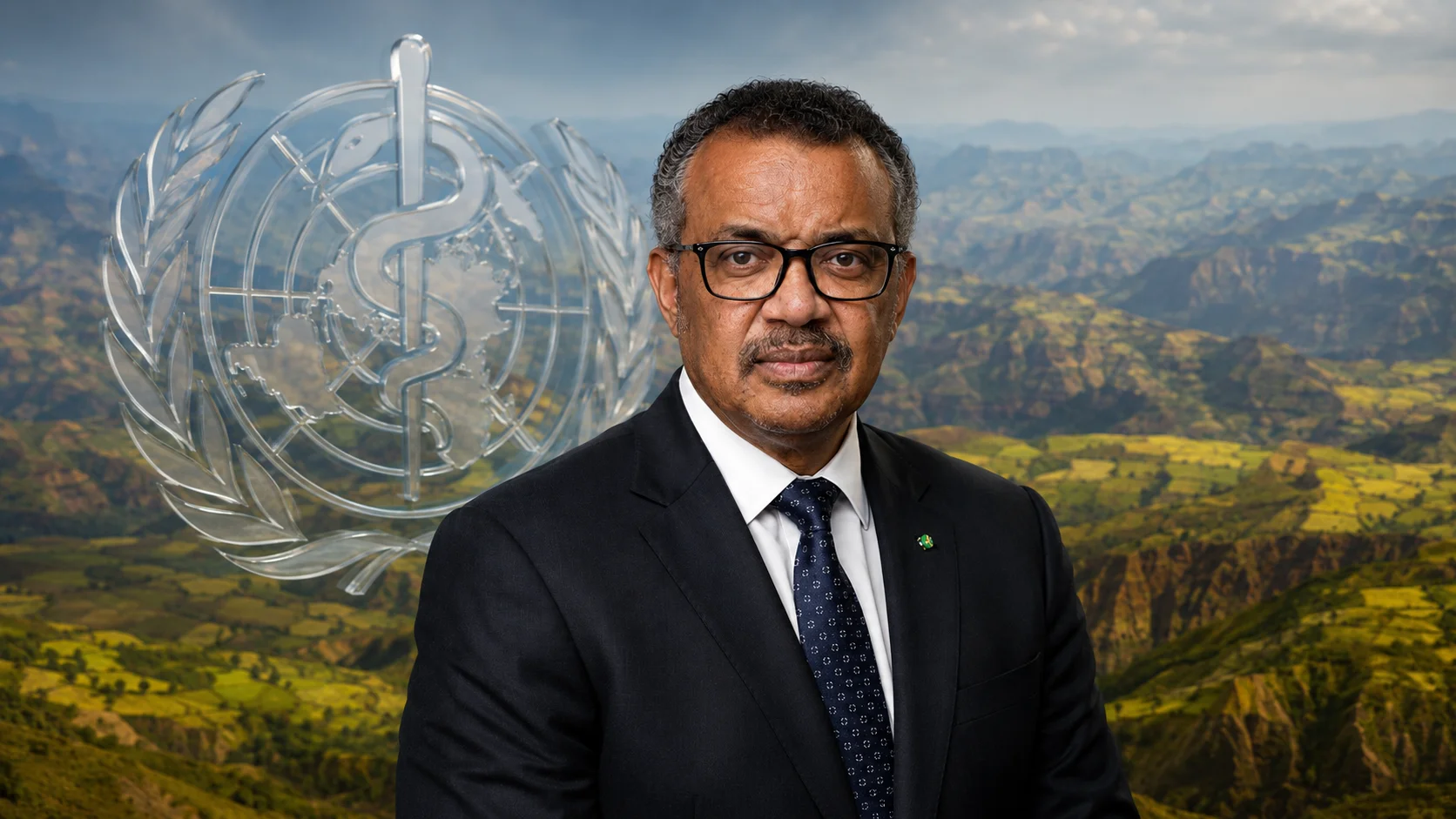
Who is Tedros Adhanom Ghebreyesus?
Born on 3 March 1965 in Asmara (then part of Ethiopia, now the capital of Eritrea), Tedros comes from a family with deep roots in Ethiopia’s northern Tigray region. His father, Adhanom Gebreyesus, was an engineer from the Seraye area, mother, Melashu Weldegabir, never held any publicly known professional or political position.
Public biographical sources provide no more details on his parents’ professions, occupations, or social status.
The emphasis in his own reflections and bios is on personal experiences growing up amid malaria, preventable childhood diseases (including the death of a younger brother around age 3–4, possibly measles), and social inequalities that affected people in the region.
Education and Career
- 1986: BSc in Biology, University of Asmara.
- Shortly after graduation, he joined Ethiopia’s Ministry of Health as a junior public health expert.
- 1988: Received a scholarship for four months of diplomat training in Denmark (early evidence of selection for international programs; he has noted receiving Danish health insurance coverage, which influenced his views on universal health access).
- 1992: MSc in Immunology of Infectious Diseases from the University of London (studied at the London School of Hygiene & Tropical Medicine - LSHTM).
- 2000: PhD in Community Health, University of Nottingham. His thesis examined the effects of dams on malaria transmission in Tigray and appropriate control measures.
No publicly available sources name a specific scholarship, sponsor, or personal “connection” for the London MSc. His MSc studies overlapped with Ethiopia’s transition from the Derg military regime (overthrown in 1991) to the EPRDF government.
Tedros himself joined the Tigray People’s Liberation Front (TPLF).
He returned to Ethiopia after the MSc and built his career through field work as a malariologist, before diving into leadership roles.
He joined Ethiopia’s Ministry of Health as a junior malariologist after his first degree and rose through regional and federal health structures.
By 2005 he was appointed Minister of Health under the TPLF-dominated EPRDF government.
In that role he oversaw a major expansion of primary healthcare, the deployment of tens of thousands of health extension workers, and ambitious malaria control campaigns.
As Health Minister, Tedros built ties with Bill Clinton and the Clinton Foundation (HIV/AIDS work).
International Roles (Pre-WHO Director-General)
While serving as Ethiopia’s Minister of Health (2005–2012), Tedros held several senior leadership positions in major global health partnerships. These were substantive governance roles that gave him direct influence over strategy, funding priorities, and coordination for some of the world’s largest disease-control efforts.
- Roll Back Malaria Partnership (RBM)
He served as Chair of the Board from 2007 to May 2009.
RBM is a longstanding global partnership (hosted by WHO and involving UNICEF, the World Bank, UNDP, bilateral donors, NGOs, and the private sector) focused on reducing the malaria burden, especially in Africa.
Its work emphasizes coordinated scale-up of insecticide-treated bed nets, rapid diagnostic testing, effective treatment (including artemisinin-based combination therapies), and integration with broader health systems.
As Chair during this period, Tedros helped steer the partnership’s strategic direction at a time when international malaria funding and coverage were expanding significantly. Ethiopia itself was a major beneficiary and implementer of these efforts under his domestic leadership.
- Global Fund to Fight AIDS, Tuberculosis and Malaria
He was elected Chair of the Board in July 2009 and served a two-year term.
The Global Fund is the largest multilateral financier dedicated to fighting HIV/AIDS, tuberculosis, and malaria.
It operates on a multi-stakeholder model with donors, implementing countries, NGOs, the private sector, foundations, and affected communities sharing governance.
At the time of his election, it had disbursed or committed tens of billions across ~140 countries and had already contributed to averting millions of deaths through treatment scale-up and prevention.
The Global Fund’s Executive Director at the time, Michel Kazatchkine, praised Tedros’s on-the-ground leadership in Ethiopia and his experience across multiple global health partnerships.
Other Notable Roles (Overlapping Period)
- Co-chair of the Partnership for Maternal, Newborn and Child Health (PMNCH) Board (2005–2009).
- Brief role chairing the UNAIDS Programme Coordinating Board around 2009.
- Member of boards including GAVI (vaccines), Stop TB Partnership, and various high-level task forces on innovative international financing for health systems (one co-chaired by Gordon Brown and Robert Zoellick).
Tedros also maintained professional relationships with key figures in the global health establishment, including Anthony Fauci, the long-time director of the U.S. National Institute of Allergy and Infectious Diseases (NIAID). Their paths overlapped for years through HIV/AIDS programs, the Global Fund, and broader infectious disease coordination.
From 2012 to 2016 he served as Minister of Foreign Affairs.
Stories surfaced accusing him of covering up cholera outbreaks by reclassifying them as ‘acute watery diarrhea’ to avoid international scrutiny and aid complications.
The 2017 Election
In May 2017, Tedros was elected Director-General by the World Health Assembly with 133 votes out of 185.
He beat the British candidate David Nabarro (a long-time UN epidemic response veteran) and Pakistan’s Sania Nishtar.
He became the first African and the first non-doctor to hold the position.
Ethiopia formally nominated him.
The African Union gave him unanimous endorsement - all 54 African member states lined up behind him.
In a one-country-one-vote system, that’s already a massive structural advantage.
China threw its weight behind him hard and ran an aggressive diplomatic campaign to line up support across Asia and beyond. Western countries (US, UK, Canada) mostly backed Nabarro.
Tedros won comfortably in the final secret ballot.
Campaign dirt was present.
During the race, stories surfaced accusing Tedros of covering up cholera outbreaks while he was Ethiopia’s Health Minister. Some of it was pushed by people connected to the Nabarro campaign.
Later, when relations between the US and China soured during COVID, American officials (including Mike Pompeo) claimed China had effectively “bought” Tedros’s election.
WHO Re-election
Tedros was re-elected unopposed for a second five-year term as WHO Director-General in May 2022 (term starting August 2022), despite strong opposition from his home country Ethiopia and ongoing accusations tied to the Tigray conflict.
He managed to secure support from European Leaders European leaders. Germany’s Health Minister Jens Spahn (and later successor Karl Lauterbach) and Foreign Minister Annalena Baerbock, along with France’s Health Minister Olivier Véran and Foreign Minister Catherine Colonna, played a prominent role in nominating and backing him, with Germany formally proposing his candidacy. Support also came from other key EU figures invested in multilateralism.
The African Union, again, gave him near-unanimous support.
He also got backing from major philanthropies such as the Bill & Melinda Gates Foundation, Wellcome Trust, Rockefeller Foundation, and Bloomberg Philanthropies, plus Western health bureaucracies (US via NIAID/Fauci and USAID, UK, Norway, Germany, France)
He is married and has five children. He identifies as an Ethiopian Orthodox Christian and presents publicly as a family man.
Scientific Works / Research Output
Tedros has a modest academic record, focused on malaria and public health in Ethiopia.
PhD thesis (2000, University of Nottingham): “The effects of dams on malaria transmission in Tigray Region, northern Ethiopia, and appropriate control measures.”
Key papers: Studies on malaria incidence near dams, community participation in control, health systems. Published in journals like Acta Tropica, BMJ, The Lancet, etc.
Total output: Around 60–70 publications (per ResearchGate/Scholia), mostly applied/epidemiological, focused on field work, dams/malaria, and health policy in Africa rather than lab breakthroughs.
~~
COVID-19 Response and the mRNA Platform
Tedros was at the center of the global response from the start:
- Early 2020: Traveled to China, met Xi Jinping, and publicly praised China’s “transparency” and containment efforts. WHO declared a PHEIC on 30 January 2020 (after some delay) and a full pandemic on 11 March.
- Key guidance: Advised against broad travel/trade restrictions early on. Messaging on masks, asymptomatic transmission, and origins evolved over time.
- Achievements claimed: Coordinated technical guidance, supported testing/ramp-up in many countries, and launched COVAX for equitable vaccine distribution.
- Major criticisms: Accused by the Trump administration and others of being “China-centric,” slow to criticize Beijing, and politicized. The U.S. temporarily withdrew funding. Questions persisted about the handling of the lab-leak hypothesis and the speed of independent origins investigation. Later, Tedros called for a more transparent origins probe.
Overall, supporters credit him with steady leadership under pressure; detractors argue WHO under him prioritized diplomacy over blunt truth-telling, especially early on.
The mRNA Platform and Technology Transfer Push
Tedros strongly embraced mRNA technology as transformative but repeatedly highlighted its limitations for global equity. Key points:
- mRNA vaccines (Pfizer-BioNTech, Moderna) proved highly effective but were initially produced almost exclusively in high-income countries, leading to massive supply imbalances.
- Tedros and WHO criticized intellectual property barriers and called for patent waivers or voluntary sharing
- mRNA Technology Transfer Hub: WHO established initiatives (notably a hub in South Africa and partnerships elsewhere) to enable LMICs to produce mRNA vaccines themselves. The goal was to reduce dependence on a handful of manufacturers and build long-term capacity. Tedros personally urged companies like Moderna to share know-how and technology more aggressively.
- Companies were reluctant to fully transfer proprietary processes and know-how.
- Broader stance: Tedros framed mRNA as a platform with huge potential (for other diseases too) but argued it exposed the dangers of concentrated production. He linked it to the need for the pandemic agreement’s equity provisions.
Peter Daszak & EcoHealth Alliance
Daszak (EcoHealth president, Wuhan lab collaborator) was on the WHO origins mission to China (2021).
Tedros later expressed frustration with the mission’s “extremely unlikely” lab-leak conclusion and pushed for further investigation. There was reported tension between Tedros and Daszak on a call regarding the report.
Daszak’s EcoHealth received NIH funding (Fauci’s institute) for bat coronavirus work.
Mpox (formerly monkeypox) PHEIC Declaration – July 2022
On 23 July 2022, Tedros declared the multi-country mpox outbreak a Public Health Emergency of International Concern (PHEIC) - only the seventh time in WHO history.
The outbreak had spread rapidly via sexual networks, mainly among men who have sex with men in non-endemic countries (Europe, North America, etc.), with over 16,000 cases reported across dozens of countries by that point.
The IHR Emergency Committee of independent experts was split on whether it met the PHEIC threshold.
Tedros exercised his authority to declare it anyway, stating it met the criteria and required coordinated international action - surveillance, contact tracing, vaccines, and risk communication targeted at affected communities.
The PHEIC was later lifted in May 2023 as cases declined sharply in non-endemic regions.
Advocacy for a Global Pandemic Treaty
Following the COVID-19 experience, Tedros strongly championed the creation of a new legally binding international instrument on pandemic prevention, preparedness, and response.
Negotiations were launched by the World Health Assembly in December 2021.
Tedros framed it as essential to fix the inequities and coordination failures exposed by COVID (e.g., vaccine hoarding by rich nations, weak surveillance, and supply chain vulnerabilities). Key pillars he pushed included:
- Stronger national capacities and “One Health” approaches
- Equitable access to vaccines, diagnostics, and treatments (including pathogen access and benefit-sharing mechanisms).
- Better financing, data sharing, and rapid response mechanisms.
- Accountability and compliance measures.
Throughout his second term, Tedros was vocal about structural problems in global health:
- Funding shortfalls: He repeatedly highlighted chronic underfunding of WHO.
- Vaccine inequity: He sharply criticized rich countries for hoarding doses while low- and middle-income countries (LMICs) waited.
- Geopolitical interference: He condemned how politics and conflicts disrupted health (e.g., blockades, attacks on health workers).
High-Profile Diplomacy and U.S. Re-engagement
Tedros continued active diplomacy. A notable moment came in January 2021 when the new Biden administration reversed Trump’s withdrawal from WHO. Dr. Anthony Fauci addressed the WHO Executive Board, announcing the U.S. would remain a member, fulfill financial obligations, and join COVAX.
Tedros warmly welcomed the move, publicly referring to Fauci in friendly terms (“my brother Tony” in some exchanges) and calling it “a good day for WHO and global health.”
The two appeared in joint or coordinated settings during COVID briefings and events, symbolizing restored U.S.–WHO cooperation.
Close Ties with Bill Gates and the Gates Foundation
Tedros has maintained a notably warm and collaborative relationship with Bill Gates and the Bill & Melinda Gates Foundation since at least 2005 - one of the most powerful unelected players in global health.
Tedros has met Gates multiple times and appeared alongside him in high-profile events (e.g., Munich Security Conference panels on pandemics).
The Gates Foundation is routinely one of WHO’s largest donors, contributing hundreds of millions over the years. Critics argue this creates dependency and gives the Foundation outsized influence over WHO priorities, turning the organization into a partial vehicle for billionaire philanthropy rather than purely member-state driven policy.
During COVID, the Foundation poured billions into the global response, including COVAX.
In short, Tedros’s partnership with Gates is a textbook example of the revolving door between high-level public health officials and ultra-wealthy private foundations - one that gives unelected billionaires significant sway over global policy.
EU Financial and Multilateral Backing
European support for Tedros went beyond diplomacy.
The European Investment Bank (EIB), for example, borrows cheaply on capital markets thanks to EU member state guarantees and deploys billions in “development” lending - roughly €3.1 billion to Africa in 2025 alone, according to EIB figures.
These flows are presented as win-win partnerships but ultimately rest on European taxpayer backing.
Tedros’s long-standing relationships with European leaders and his emphasis on multilateral health/development financing aligned neatly with this system.
~~
Ethiopian Political Background
- TPLF and EPRDF Rule (1991–2018)
The Tigray People’s Liberation Front (TPLF) is a political and military movement from Ethiopia’s small Tigray region (ethnic Tigrayans make up roughly 6–7% of the population).
In 1991, the TPLF-led coalition known as the EPRDF (Ethiopian People’s Revolutionary Democratic Front) overthrew the brutal Derg military dictatorship.
For the next 27 years, the TPLF dominated the EPRDF coalition and effectively controlled the federal government, military, security services, and much of the economy despite the country’s “ethnic federalism” system. Critics accused the TPLF of authoritarian rule, corruption, ethnic favoritism toward Tigrayans, and suppressing political opposition. Supporters credited the period with rapid economic growth and infrastructure development.
- The 2014–2018 Protests and Power Shift
Widespread discontent with TPLF/EPRDF dominance boiled over in 2014–2016, especially among the Oromo (Ethiopia’s largest ethnic group). Protests began over a controversial plan to expand Addis Ababa into surrounding Oromia farmland (the “Addis Ababa Master Plan”), seen as a land grab and symbol of marginalization.
The protests spread and turned violent. Security forces responded with lethal force, mass arrests (tens of thousands detained), and a state of emergency (2016–2017). Human rights groups documented hundreds of deaths from excessive force. Similar unrest later erupted in Amhara regions.
The crisis forced Prime Minister Hailemariam Desalegn to resign in early 2018.
The EPRDF then selected Abiy Ahmed (an Oromo from within the coalition) as the new prime minister. Abiy promised sweeping reforms: releasing political prisoners, lifting the state of emergency, reconciling with Eritrea, and reducing TPLF influence. He later dissolved the EPRDF and created a new party (Prosperity Party), effectively sidelining the TPLF.
- The Tigray War (2020–2022) and Renewed Attacks on Tedros
Tensions between the federal government (led by Abiy) and the TPLF escalated after the TPLF held regional elections in Tigray in September 2020 that the federal government deemed illegal. In November 2020, federal forces launched a military operation in Tigray. Eritrea and some Amhara forces joined the federal side.
The war was extremely destructive. Independent investigations by the UN, Human Rights Watch, and Amnesty International documented war crimes and crimes against humanity by all sides.
In November 2020, Ethiopia’s army chief publicly claimed Tedros had helped the TPLF procure weapons - an allegation Tedros denied and for which no public evidence was provided. Ethiopian officials also accused him of lobbying internationally against Ethiopia.
The war formally ended with a peace agreement in November 2022 (the Pretoria Agreement), though tensions and some violence have continued in parts of the region.
~~
The 2013–2015 Allegations
Steinman, a long-time critic of the TPLF who advised Ethiopian opposition movements and supported the political changes that brought Abiy Ahmed to power in 2018, alleged that Tedros was one of three senior officials effectively controlling Ethiopia’s security apparatus between 2013 and 2015.
During those years, security forces violently suppressed protests.
Human rights groups documented hundreds of deaths from excessive force, mass arrests, and a subsequent state of emergency. Steinman argued that Tedros, as a top decision-maker in the government, bore responsibility for these crimes against humanity and pushed for ICC prosecution.
The US State Department human rights reports from the period criticize the Ethiopian government broadly for failing to rein in security forces, but they do not name Tedros personally.
Steinman’s complaint gained media attention in late 2020 but never resulted in any ICC investigation or charges.
The Tigray War and Fresh Accusations
A second layer of claims emerged after the Tigray war broke out in November 2020.
Ethiopian military chief General Birhanu Jula publicly accused Tedros of helping the TPLF procure weapons.
The Ethiopian government responded by accusing him of bias, spreading misinformation, and abusing his WHO position to support the TPLF (which Addis Ababa had designated a terrorist group).
Independent investigations by the UN, Human Rights Watch, and Amnesty International found that all parties committed serious violations during the war - war crimes and crimes against humanity including mass killings, rape, and ethnic cleansing in Western Tigray. The legal term “genocide” remains contested and has not been formally determined by an international court in this conflict.
Das könnte dich auch interessieren