Trump Likes His Heart. Trump Takes Aspirin.
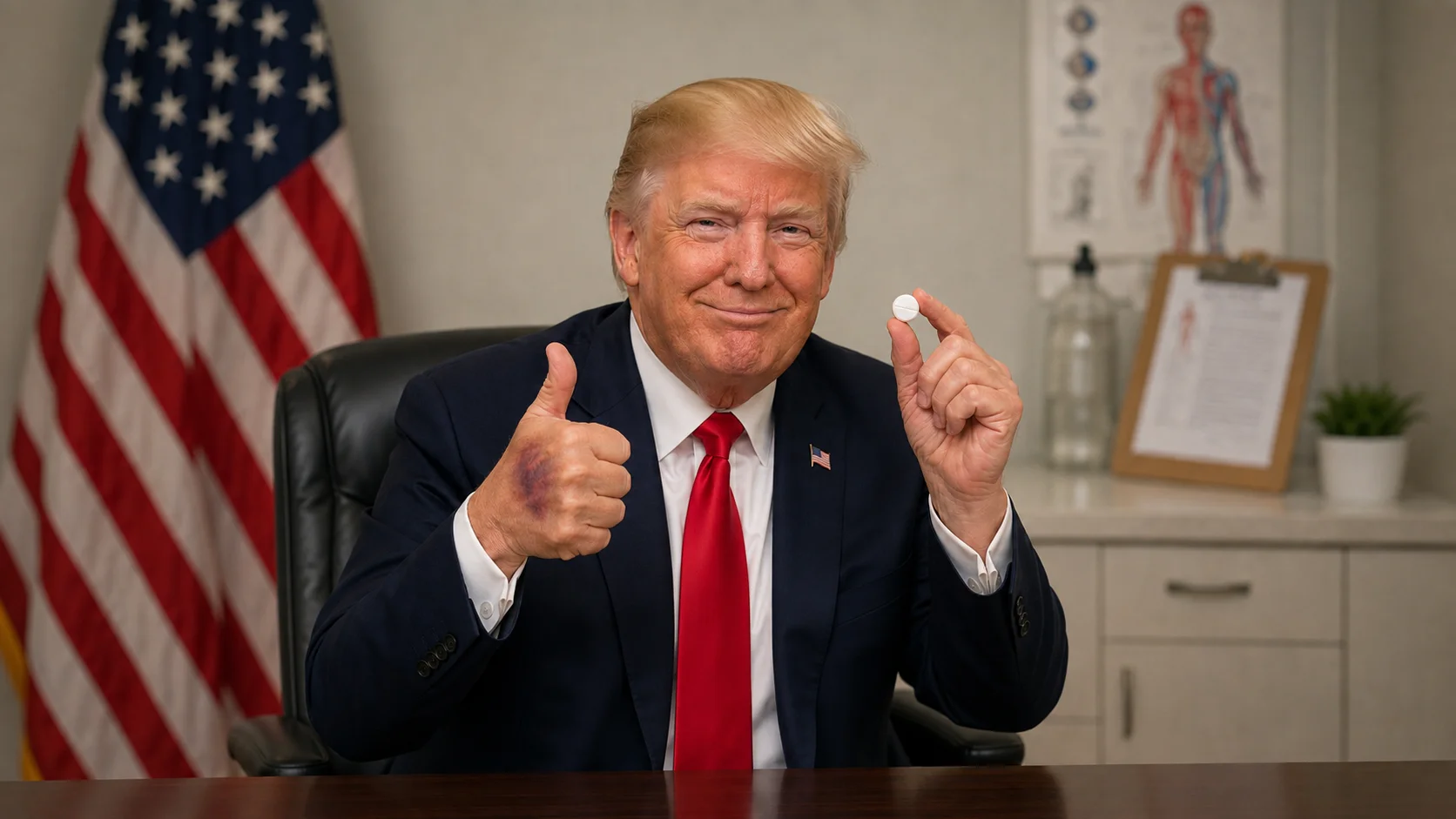
On the flight back to the United States aboard Air Force One, a reporter asked him about it.
“We saw the bruising on your hand. Are you okay?”
“I’m very good. I clipped it on the table,” Trump replied.
He said he had put some cream on it, then offered a considerably more interesting explanation for why such a minor collision had produced such a visible result.
“I would say take aspirin if you like your heart, but don’t take aspirin if you don’t want to have a little bruising.”
Trump takes what he calls “the big aspirin.”
Earlier that month he had disclosed that this means 325 mg daily, rather than the lower dose his doctors would prefer.
His reasoning is characteristically uncomplicated.
“The doctors said, ‘You don’t have to take that, sir. You’re very healthy.’ I said, ‘I’m not taking any chances.’”
There is nothing particularly mysterious about the bruising either.
Aspirin is an antiplatelet drug. It inhibits an enzyme in platelets called cyclooxygenase-1, reducing the production of thromboxane A2, one of the signals that helps platelets activate and stick together. In considerably less pharmaceutical English - aspirin makes it harder for platelets to build a clot.
Aspirin has been used for decades in the prevention of thrombosis and certain heart attacks and strokes. It is also why somebody taking aspirin can bruise more easily.
So Trump’s explanation is entirely plausible: table meets hand, aspirin meets platelets, bruise becomes considerably more photogenic.
Trump apparently understands the trade-off perfectly well.
His doctor has given him an opinion. Trump has listened to it. He knows that his chosen dose makes him more prone to bruising, and he has nevertheless decided that, for him, the potential cardiovascular benefit is worth accepting that cost.
Doctors provide expertise, diagnoses, probabilities and recommendations. They do not acquire ownership of the patient. Ultimately, an informed adult still has to decide which risks he is prepared to take, which risks worry him more, and what he wants to put into his own body.
Trump has made that decision for himself.
That is called taking responsibility for your own health.
And perhaps more of us should.
Medical knowledge matters. Recommendations, however, are not eternal truths. Evidence changes, studies disagree, guidelines are revised. Yesterday’s certainty is tomorrow’s footnote.
Eggs alone spent decades travelling between breakfast staple, cardiovascular menace and respectable source of protein, depending on which decade’s expert consensus happened to be shouting loudest.
Neither television experts nor newspaper headlines should replace understanding what is being recommended, why it is being recommended, and deciding for yourself.
Sources
Mohlo by vás zaujímať