Brussels Wants Its Own Taxes. It Already Paid for the Advertisement - You Are the One Who Finances It
What forms the EU budget, actually? What does it buy? How does it sit on top of the budgets that already take half of what the economy produces? How deep is the new Union debt? Who pays it back? And why is the Commission hunting for “own resources”?
Two public purses, not one
A national budget belongs to your state. It pays pensions, hospitals, teachers, police, interest on a mountain of old debt, and - if anyone is still awake - roads.
The EU budget is a transfer-and-programme machine of about €190–210 billion a year, or roughly 1% of EU GNI. Combined public spending of the 27 member states sits near half of GDP. EU GDP in 2025 was about €18.8 trillion. So today, the Union today's "own" budget is a sliver next to the real state.
Where the EU's "own" money comes from
Rough anatomy of the current revenue model:
- GNI resource - the balancing item. Your country pays a share of its national income. A club fee.
- Traditional own resources - customs duties at the external border, minus a collection fee the member state keeps. The oldest Union money.
- VAT-based resource - a slice calculated from a harmonised VAT base. A statistical claim on a tax you already pay.
- Plastics own resource - a levy on non-recycled plastic packaging waste. The first “green” statistical tap. Member states pay Brussels per kilogram they fail to recycle. A Union charge dressed in green.
- Other - leftovers, fines, assigned revenue. Competition fines on firms land in the EU budget, not in the national treasury that prosecuted them.
The outcrops of EU wanting MORE are already here.
Plastics was the pilot: pick a metric, apply a rate, send the invoice to the finance ministry, call it European.
Fines taught the same lesson - money can arrive in Brussels without a GNI debate.
That model has a political property national budgets do not share: the people who vote the taxes are not the people who spend them.
The Commission’s complaint is that this still makes it a beggar. The proposed cure is to grow the outcrops into a tap that forms direct Union revenue.
EU's permanent shopping list
- Farmers and land. Direct payments and rural development. France lives here. So do Spain, Italy, Germany, Poland.
- Cohesion. The other fat brick. Concrete, training schemes, “resilience,” and the heading that also swallows “values.” Poland is the cohesion whale. Italy and Spain cash both cohesion and the recovery slush. Austria and the Netherlands get the postcard.
- Research and single-market programmes. Horizon and friends. Higher error rates, nicer press releases.
- Outside the Union. Neighbourhood, Development and International Cooperation - Global Europe / NDICI - is about €80 billion for 2021–2027, more than 70% of the EU’s external-relations pot. Geographic programmes cover the Southern Neighbourhood, Sub-Saharan Africa, the Middle East and Central Asia, Asia-Pacific, the Americas. On top sit humanitarian lines, pre-accession money, and the new Ukraine machinery. Team Europe - EU budget plus member states - has put about €193–200 billion into Ukraine since 2022.
The media massage - why the federalist advertisement peaks now.
Citizens, Equality, Rights and Values (CERV) is €1.55 billion for 2021–2027.
Creative Europe and the Commission’s multimedia actions pay news networks and “media literacy.”
The next-MFF upgrade is AgoraEU, proposed at €8.6 billion (Parliament wants more): Culture, MEDIA+ (~€3.2 billion), CERV+ (~€3.6 billion).
Wider NGO plumbing - over €7 billion to more than 12,000 organisations in a three-year slice.
Producing that much propaganda is not a hobby and not a coincidence.
"Own resources" need a public that already thinks of Brussels as an established government - values, “European democracy,” a media layer that treats Union as the Great Soviet.
What changed in 2020: the Union borrowed - and kept issuing
Until 2020 the EU budget was, in the boring sense, balanced. It spent what member states and customs put in.
In 2020, the Governments authorised the borrowing machine.
NextGenerationEU was sold as a one-off recovery fund. The legal ceiling was €807 billion. Uptake was later cut to about €638 billion. By end-2025 the Commission had disbursed €469 billion of it:
- €238 billion in RRF grants (the common budget’s problem)
- €156 billion in RRF loans (the borrowing country’s problem - Italy the whale)
- €76 billion topping up existing EU programmes
Same printing press, new customers. Ukraine loan stock at the Commission was €70 billion by end-2025.
Then the €90 billion support loan for 2026–2027.
Macro-financial assistance, the Ukraine Facility, SAFE defence loans, Western Balkans paper — all fed from 2023 by a unified funding approach: one EU-bond programme, many outgoing cheques.
The Commission no longer matches a bond to a beneficiary. It raises a pool and allocates later.
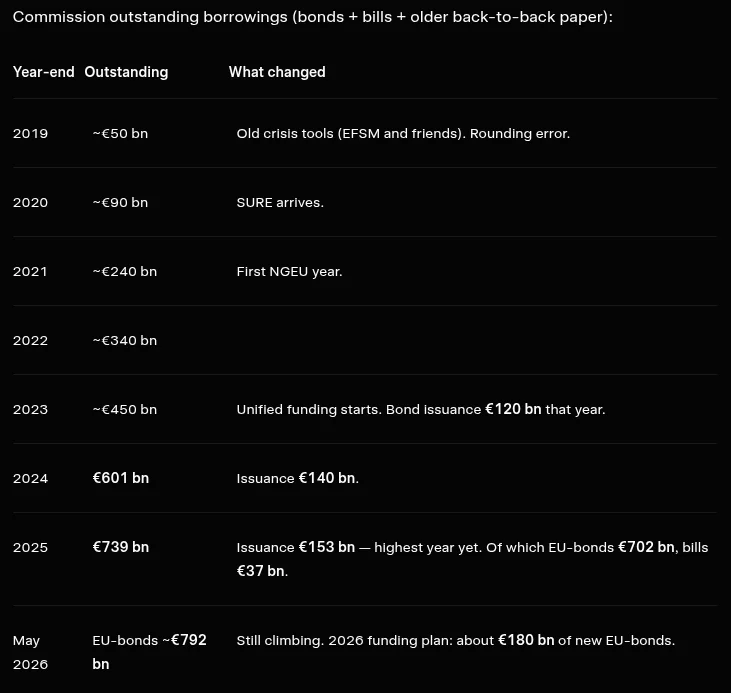
Pre-pandemic the Union was not a capital-market sovereign. Five years later it issues like a mid-sized state.
New as a species: Union-branded debt on a budget with no income tax.
Who owes what
- NGEU loans - the member states borrowing directly from Brussels and pay back to Brussels.
- NGEU grants - Commission borrows money and gifts them a grant to a country, everyone pays back. Price? Everyone services that bond from 2028: about €24 billion a year (€168 billion over 2028–2034).
- Ukraine and third-country loans - The Union borrows and lends to Ukraine (and some other third countries). On paper, Ukraine owes the money. In reality, if Ukraine cannot service the loan, you pay.
The cushions are not a surplus. They are spent.
The Union is not insolvent. Customs still arrive. Finance ministries still write the GNI cheque.
What ran out is the shock absorber inside the seven-year cap.
The Commission’s own 2025 management report: unexpected challenges “overwhelmed the EU budget’s limited flexibility,” leaving “almost no unallocated funds” with two years left in the cycle.
The 2026 budget again empties the Flexibility Instrument and the Single Margin Instrument. Several headings sit at a zero margin.
The overdraft facility is maxed, while the €24 billion repayment line that switches on in 2028 cannot be absorbed by the old tricks. Either programmes are cut, national contributions rise, or Brussels gets new "own" money.
Who repays
Not “Europe.” Not a fund in Luxembourg. The taxpayer.
EU conveniently creates five new "EU own money" taps, Commission estimates, average year, 2025 prices
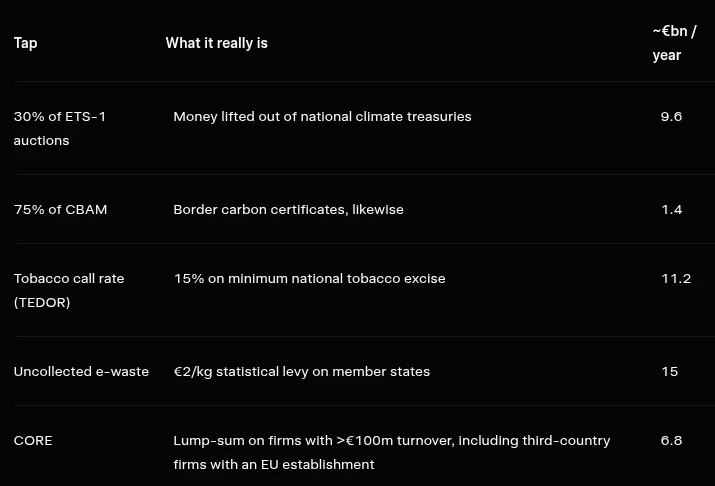
About €44 billion a year from the new basket, €58 billion with tweaks to old resources.
Sold as “less pressure on national contributions.”
ETS and CBAM cash that used to land in national budgets will land directly in Brussels.
The novelty is CORE - a direct corporate tribute to the Union.
CORE is the first time Brussels invoices the companies directly.
EU Inc. - the new company model EU is promoting - is the first time it wants to register the company.
Neither is a fully stateless firm, yet.
Together they are the same move: the Union dealing with capital without the national budget as middleman.
Already-taxed populations is not a metaphor. EU-27 government expenditure is about half of GDP. Adding Union-level claims on ETS, tobacco, waste and corporate turnover does not create a new planet of untaxed rich. It re-routes money that was already in the fiscal bloodstream.
The EU budget is a second public purse, about a fiftieth the size of national public spending, funded by taxpayers who already pay a social-democratic state. It spends a fat share on redistribution inside the club, a loud share on NGOs and media, and a growing share outside the club - Ukraine first, then the neighbourhood and Africa.
In 2020 it added Union debt, which must be serviced (paid back) starting 2028.
The Commission’s plan is not to shrink the purse. It is to give the purse its own taxes so national parliaments lose the only lever they had: refusing the cheque.
The NGO and media money is how you sell that as “better Europe”.
Mohlo by vás zaujímať