Unemployed? Lose Weight or Die. Either Way, You’re Off the Statistics.

Britain has finally located the missing link between public health and labour productivity: the syringe.
With 29% of adults obese, 64% overweight, obesity-related illness costing the NHS an estimated £11 billion a year and diabetes another £10 billion, Keir Starmer declared weight-loss jabs “very important” for both the NHS and the economy, while Wes Streeting noted that obesity costs workers an average of four extra sick days a year and can push some out of employment altogether.
The solution, naturally, was to run an initiative. Or two.
1
The first was the five-year SURMOUNT-REAL UK study, announced in October 2024 as part of a £279 million collaboration between Eli Lilly and the UK government. Based in Greater Manchester and sponsored by Lilly, with Health Innovation Manchester, the University of Manchester and NorthWest EHealth involved, the phase 4 trial began recruiting through GP practices in late 2025.
Around 3,000 adults with Class I obesity, no diabetes and at least one weight-related condition are being randomised to receive tirzepatide (Mounjaro) alongside standard care or standard care alone.
Researchers will track weight loss, progression to type 2 diabetes, obesity-related complications, quality of life, GP and hospital use, productivity, employment status and sickness absence using real-world NHS data.
2
The second programme was rather larger. NHS England began a phased national rollout of tirzepatide (Mounjaro) under NICE guidance, with around 220,000 people expected to receive treatment during the first three years and a potentially eligible population of roughly 3.4 million.
The rollout is still in the early, capacity-constrained phase.
Specialist weight-management services gained access in March 2025, primary care followed in June, and eligibility is being widened gradually from patients with the highest BMI and the greatest number of obesity-related conditions.
The rollout includes continuing monitoring of prescriptions and outcomes, an independent NIHR evaluation of safety, effectiveness and cost-effectiveness, and a later NICE review before access expands further, potentially over as long as twelve years.
Treatment is supposed to accompany a reduced-calorie diet and increased physical activity.
GLP-1 receptor agonists work by mimicking glucagon-like peptide-1, a hormone released after eating.
They increase insulin release when blood sugar is high, reduce glucagon production, slow the rate at which food leaves the stomach and act on appetite centres in the brain, making people feel full sooner and remain full longer. The result is usually lower calorie intake and weight loss.
Semaglutide is a single GLP-1 receptor agonist (Ozempic, Wegovy).
Tirzepatide (Mounjaro, Zepbound) goes a step further by activating both GLP-1 and GIP receptors, another hormone pathway involved in blood-sugar control and appetite.
Streeting called the drugs potentially “monumental”, NHS chief Amanda Pritchard called them a “game-changer”. Prime minister, Sir Keir Starmer said government had to “think differently”.
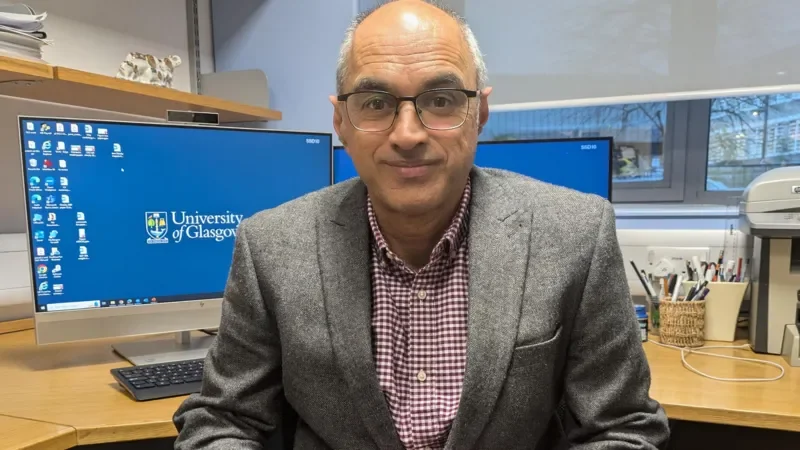
Naveed Sattar, professor of metabolic medicine at the University of Glasgow and chairs of the UK government’s obesity mission explained that "there’s enough evidence available that these drugs have strong meaningful weight loss, that the side effect profiles are generally ok for the vast majority of individuals."
https://www.bbc.com/news/articles/cz6jg6nw2zeo
By August 2026, use of GLP-1 and dual-agonist drugs in Britain had already moved far beyond specialist treatment and is becoming a national habit.
A UCL/BMC Medicine survey published in January 2026 estimated that around 1.6 million adults in Great Britain had used one of the drugs for weight loss during the previous year, while later estimates placed current use somewhere up to 2 million people, most paying privately.
More strikingly, one industry survey found usage had risen from 3.1% of UK adults in mid-2025 to almost 6% by early 2026, meaning roughly one in every seventeen adults was using one of these medicines.
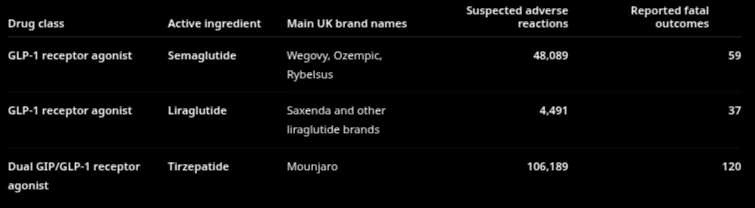
Two years later, the Medicines and Healthcare products Regulatory Agency has received reports covering more than 158,000 suspected adverse reactions, including 216 reports with a fatal outcome.
Use elsewhere in Europe:
Denmark
By February 2025, roughly 3.6% of the entire population who had used Wegovy, before even adding Ozempic, Rybelsus, liraglutide or tirzepatide. Among adults, the proportion would naturally be higher. That figure is already more than a year old.
Netherlands
The Dutch numbers are much lower, at least in the part the government can actually see. In 2024, 116,520 people received semaglutide through the Dutch insured system, up from just 26,153 in 2020. Another 23,644 received liraglutide. Privately purchased weight-loss treatment largely disappears from these figures.
Italy shows the scale through packs rather than people.
AIFA says reimbursed semaglutide consumption went from about 322,000 packs in 2020 to more than four million packs in 2024. Private purchases of medicines specifically authorised for weight management jumped 142.8% in 2024.
France is almost comically difficult to measure.
During its tightly controlled early-access programme, only 7,048 adults initiated Wegovy between July 2022 and September 2023. Wegovy then entered the normal French market in October 2024 without reimbursement. The French medicines regulator explicitly noted that because patients were paying privately, national health-insurance data could not track prescriptions and sales properly.
Germany has essentially the same problem for obesity treatment because weight-loss medication has traditionally not been reimbursed by statutory insurance.
German studies show rapidly rising GLP-1 use, and semaglutide is already the dominant drug in outpatient samples, but there are no hard numbers.
Facit, a rough calculation from the british self reported data shows a death rate of 0.0108 - 0.0144%.
Compared to the seasonal influenza case fatality rate (roughly 0.1%) - the flu’s usual case fatality rate is roughly 7–10 times higher than the crude arithmetic from the British self-reported weight loss drug data.
Looks safe, doesn't it?
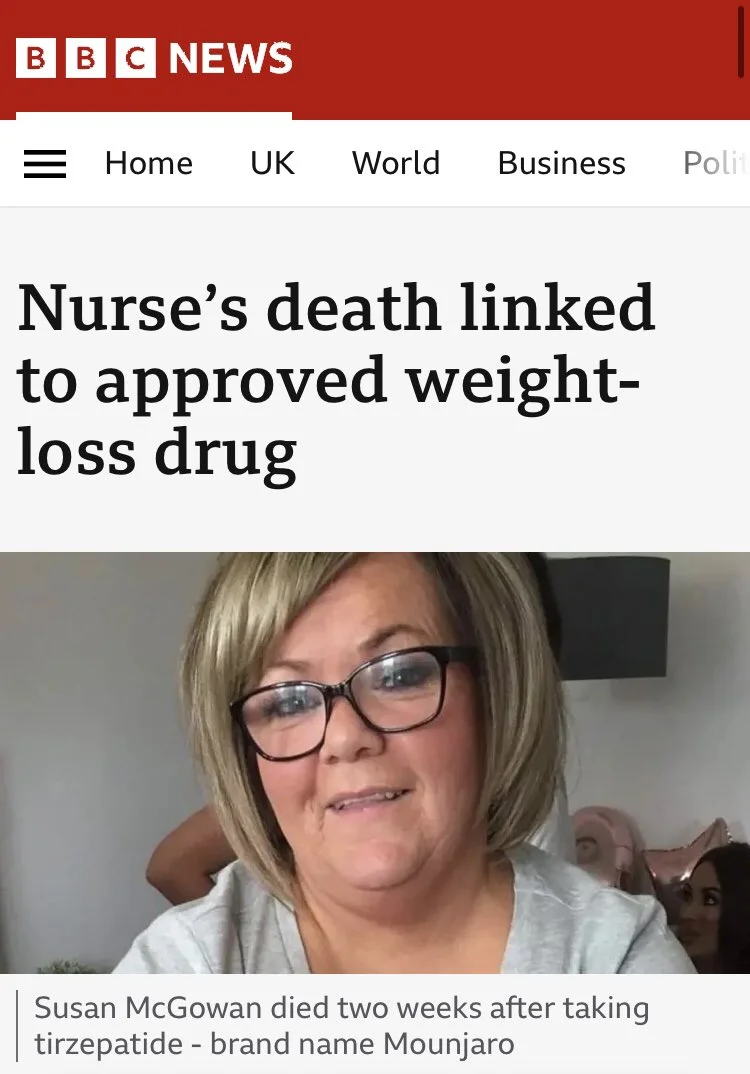
For Susan McGowan, a 58-year-old nurse in Scotland, the experiment lasted considerably shorter.
She obtained Mounjaro legally from a registered pharmacy, took two low-dose injections over two weeks, developed severe stomach pain and sickness. She was admitted to hospital with pancreatitis, her kidneys failed, she developed septic shock and multiple organ failure, and she died. Her death certificate recorded “the use of prescribed tirzepatide” as a contributing factor.
Britain has found a way to improve both the obesity numbers and the unemployment figures at the same time.
Sometimes with the same injection.
As for everybody else, perhaps, before volunteering for the latest population-scale pharmaceutical rollout, just don’t stuff that much.
You might also like