Welcome to Austria – The Country With One of the Highest Non-EU Migration Rates Per Head

The Hard Numbers (2010–2025)
Here is the clearest picture available from Statistik Austria and the Federal Ministry of the Interior:
1. Asylum Applications (2010–2025)
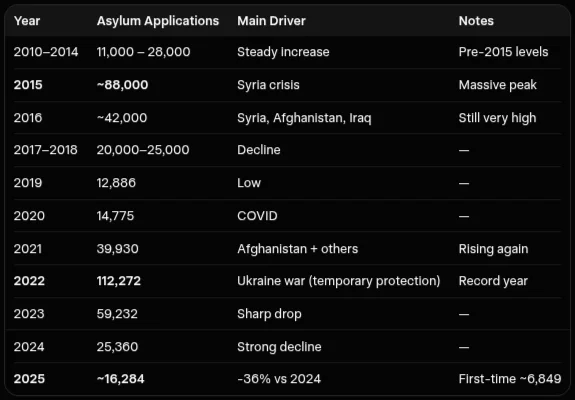
Even rejected asylum seekers who are not deported remain in Austria and are included in the official migration statistics. They count toward the 2.55 million people with a migration background.
Key waves:
- 2015–2016: ~130,000+ applications (mostly Syria, Afghanistan, Iraq)
- 2022: 112,000+ (mostly Ukrainians)
2. Overall Foreign Migration & Net Migration
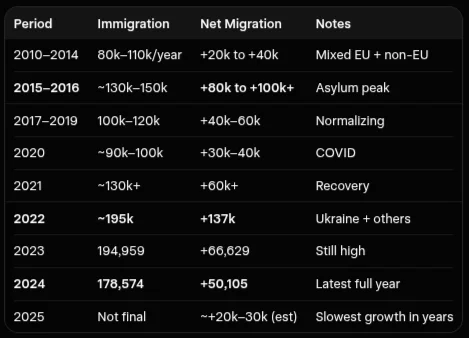
Critical fact: In 2024, 68 % of net migration (+37,869 people) came from non-EU third countries.
3. People with Migration Background (1st + 2nd Generation - ALL sources)

4. Naturalizations (New Austrian Citizens)
This is where the picture becomes even clearer:
- Naturalizations have risen sharply in recent years.
- 2025: 17,649 people were naturalized in the first 9 months alone (+11.5% compared to 2024).
- In recent years, the largest groups gaining Austrian citizenship have been from Syria, Turkey, and Afghanistan.
- A large additional group consists of descendants of Nazi victims (many living abroad) who receive citizenship under special rules.
Many of the people who arrived during the 2015–2016 wave are now becoming Austrian citizens — while their children (2nd generation) are already growing up as Austrians.
The Secret Numbers
In 2024, Austria recorded a net migration of +50,105 people.
Of this, 68 % (+37,869) came from third countries (non-EU).
Only 32 % came from other EU/EFTA/UK countries.
This is not a one-off. Since 2015, the dominant driver of Austria’s demographic change has been non-EU migration - especially from Syria, Afghanistan, Turkey, Iraq, Somalia, Iran, and parts of the NON-EU Western Balkans.
Compare this to most other Western European countries: many have higher total immigration, but a much larger share comes from within the EU.
Austria stands out precisely because of its high non-EU intake per capita.
The Data Blackout
Despite all these dramatic changes, Austria has:
- No new religion statistics since 2021.
- No tracking of 3rd generation migration background (grandchildren of immigrants).
- As of 2025, 2.55 million people (27.8 % of the population in private households) already have a migration background. Of these, roughly 634,000 belong to the 2nd generation.
We know that in Vienna, Muslim pupils already make up 41.2 % of schoolchildren.
Nationally we have no updated figure because the state stopped collecting the data.
Bottom Line
Austria has one of the highest non-EU migration rates per head in Western Europe.
Between 2010 and 2025 the country received a net 1.4 – 1.6 million foreign immigrants.
A very large share of this came from Muslim-majority countries through asylum and family reunification.
At the same time, we have deliberately stopped measuring religion and stopped tracking what happens after the 2nd generation.
“Muslims in the EU” – follow up
In our previous analysis we showed how EU-wide statistics are often manipulated to downplay Muslim population growth. Austria is a textbook example.
Officially, we are flying blind.
We cannot reliably track or estimate the exact number of Muslims in Austria in 2025/2026.
What we do know:
- The number has almost certainly risen since 2021 because of:
- Continued high non-EU migration from Muslim-majority countries (Syria, Afghanistan, Turkey, etc.)
- Higher average fertility rates among some of these groups
- Family reunification
- In Vienna, we have very strong indirect evidence: Muslim pupils made up 41.2% of all primary and secondary schoolchildren in the 2024/25 school year.
- Nationally, any number you see today (e.g. “10%” or “13%”) is just an estimate - not official data.
The 1.6 million figure is real.
The question is: What kind of Austria are we actually building?
~~
Addendum:
Austria vs Greece: Two Very Different Types of Migration
While Greece receives significantly more total arrivals than Austria, the nature of migration in both countries is very different.
In Greece, many asylum seekers pass through quickly and leave again - especially since the country introduced stricter migration policies in recent years. However, Greece has seen a clear increase in qualified and wealthy migrants from other European countries who choose to stay long-term. This includes British citizens (who became third-country nationals after Brexit), Germans, Scandinavians, Dutch, and some Austrians who move to Greece for retirement, remote work, or lifestyle reasons.
In short: Greece is increasingly becoming a destination for affluent Europeans, while Austria combines high EU migration with very high non-EU settlement.
Interestingly, while Austria attracts very high non-EU immigration, around 235,000 Austrians have left the country since 2015 - mostly heading to Germany, Switzerland, US, UK, Australia and Canada.
You might also like