Westerners Learn How Their Taxes Contributed to Stability, Migration and Worldwide Ideology Export

Western governments have long claimed that foreign aid stabilises troubled regions and prevents problems from reaching home. Let's take a look at the hugest recipients of foreign help.
Palestinian Authority
The Palestinian territories are where the donor model stops looking like emergency aid and starts looking like a subscription service
In 2005 Israel unilaterally withdrew from Gaza, leaving behind greenhouses, infrastructure and the foundations of a working economy. Within a couple of months the new Palestinian leadership largely destroyed or looted what had been left behind.
In 2006, Hamas won the Palestinian legislative elections, the last parliamentary elections held in the Palestinian territories. Since then, the Palestinian Authority has remained heavily reliant on outside funding, with foreign aid financing large parts of its budget in key years.
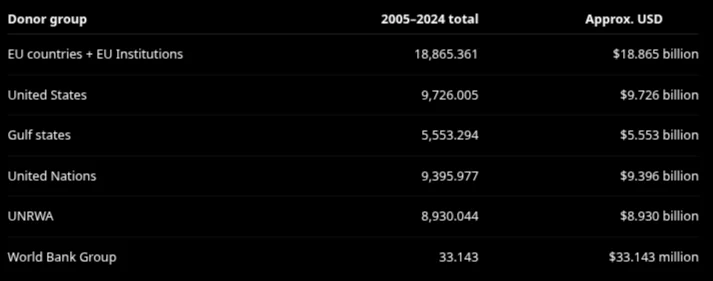
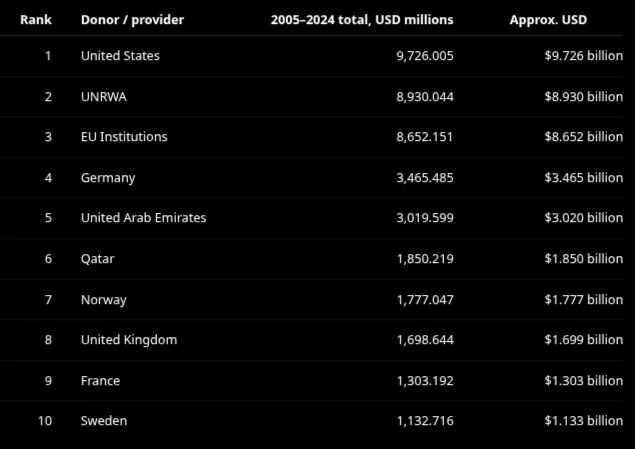
From 2005 to 2024, OECD official-flow data shows that
- EU countries together with EU Institutions provided roughly $18.9 billion USD.
- The United States provided about $9.7 billion.
- Gulf states, including Saudi Arabia, Qatar, the UAE, and Kuwait, provided about $5.6 billion.
- The UN system appears at roughly $9.4 billion, with UNRWA alone accounting for about $8.9 billion of that figure (don't add).
- Israel has also continued supplying much of the electricity and water used in the West Bank and Gaza.
After the Hamas attack of 7 October 2023 the EU and other Western donors, obviously, significantly increased their aid.
The European Union released further emergency support in 2024 and 2025, including large humanitarian packages and a multi-year Palestinian recovery and resilience programme worth up to €1.6 billion. These additional sums came on top of the already high baseline funding that had existed for years.
Nobody paused to ask whether decades of funding had produced positive results.
The Palestinian Authority has also maintained prisoner and “martyr” payment programmes, condemned by Israel and the United States as rewarding terrorism.
The largest individual donor and provider rows now enter the stage for the Golden Shovel Award:
Syria - since 2011
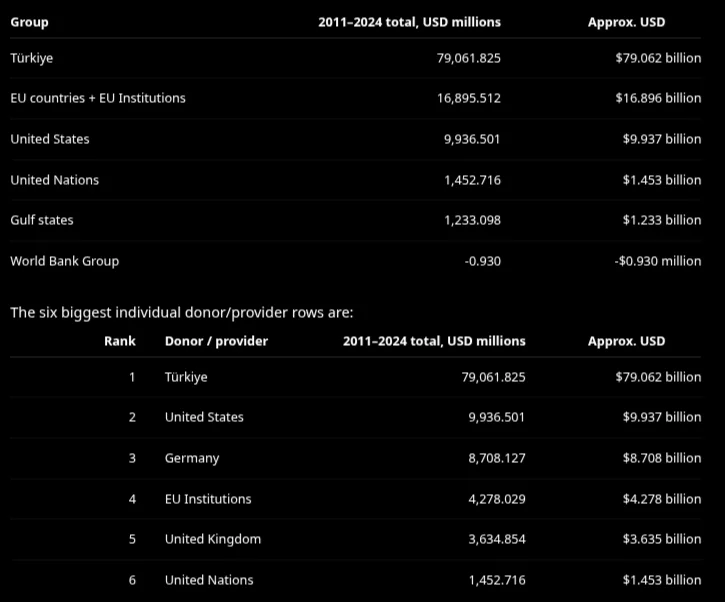
Since the outbreak of the civil war in 2011, the European Union together with its member states has provided more than €41 billion in total assistance.
The United States contributed well over $10 billion in humanitarian assistance over the same period.
Gulf states, led by Saudi Arabia, added several billion more through direct support and humanitarian channels.
Western donors who spent years backing “moderate” opposition elements and channelling aid into opposition-held areas now find themselves engaging the Jolani-led authorities and announcing fresh recovery packages worth hundreds of millions for the post-Assad transition.
The civil war did not produce stable institutions or a pro-Western order. It ended when Abu Mohammad al-Jolani - the rebranded former al-Qaeda and al-Nusra Front commander who leads Hay'at Tahrir al-Sham - marched into Damascus in December 2024 and took power. The same HTS networks that once controlled Idlib and fought under jihadist banners are now the de facto government.
Large-scale displacement from Syria continued for years, with 6 million Syrians eventually reaching foreign and European streets. Europeans have grown so accustomed to the resulting problems that many now refer to them simply as “the daily incident,” while their governments continue to approve further support both inside Syria and through external humanitarian channels.
Even after the change of power, returns have stayed limited. Jolani and his HTS authorities are not issuing passports or actively facilitating the repatriation of those who left. At the same time, the new government in Damascus openly describes the millions of Syrians living in Europe as a strategic resource - useful for remittances, political influence and long-term leverage.
Nobody paused to ask whether decades of funding had produced positive results. The measurable outcome is permanent demographic change in several European countries, ongoing integration failures, and a new ruler who treats the diaspora as an asset while refusing to let many come home.
Afghanistan (post-Taliban takeover, 2021–2025)
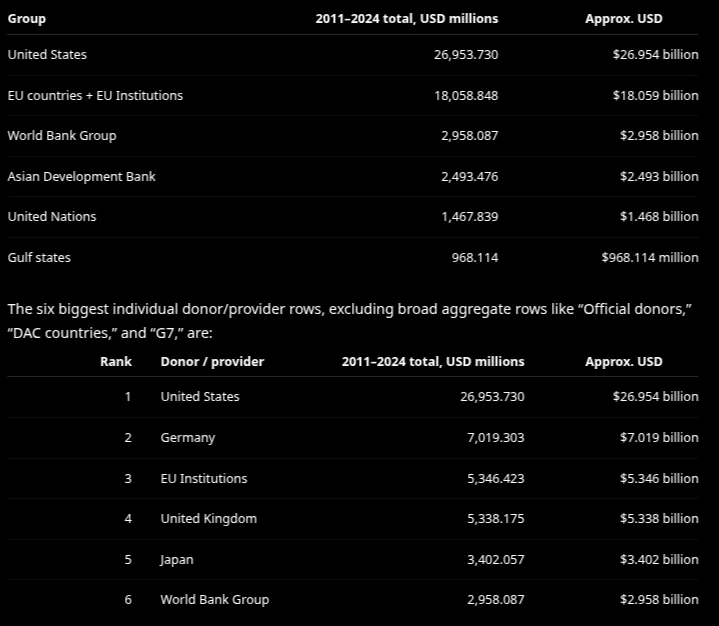
After the Taliban takeover in August 2021, the United States disbursed more than $3.8 billion in humanitarian and development assistance.
The EU provided more than €860 million in humanitarian aid over the same period.
Gulf states contributed low hundreds of millions in targeted support.
The Taliban taxed the aid flows directly. SIGAR documented over $10 million in taxes, fees and “security” payments extracted from US-funded humanitarian projects between 2021 and 2023 alone. NGOs reported Taliban commanders demanding cuts, directing portions of aid to regime priorities, and in some areas clawing back 60-100% of cash distributions from recipients.
At the same time, Afghan asylum claims remained high in Europe and the US.
In the EU, Afghans lodged over 100,000 first-time asylum applications in 2023 alone and stayed among the top nationalities in subsequent years. Many arrived via irregular Mediterranean or Balkan routes or small-boat crossings to the UK. Protection grant rates frequently exceeded 70-80%. The US saw continued claims plus parole and evacuation programmes for at-risk Afghans.
Despite the billions, the Afghan economy contracted sharply, poverty and food insecurity soared, and the Taliban consolidated power while enforcing their version of Sharia - including bans on girls’ education and most female employment.
In 2025 the US administration terminated or restructured the large majority of remaining programmes.
The EU continued its humanitarian baseline (over €161 million allocated for 2025, with similar levels planned for 2026), acting once again as the backstop that keeps overall Western flows from collapsing.
The aid was presented as emergency relief that would not benefit the regime.
The measurable results were a taxed and partially diverted aid pipeline sustaining a theocratic government, plus continued high asylum pressure on Western borders from people fleeing the very conditions the funding helped freeze in place.
The Border Reality
EU spending on external border management and Frontex for the 2021–2027 period totalled approximately €12 billion (€5.6 billion for Frontex and €6.2 billion for the Border Management and Visa Instrument). Annual spending in recent years has run between €1 billion and €2 billion — which is not comparable to the aid being shipped abroad.
Trump Cuts vs EU Response
In 2025 the US administration cancelled or restructured roughly 83% of USAID programmes, including many linked to these regions, and shifted remaining functions toward stricter national-interest criteria.
Whenever the United States has reduced or suspended aid in the past, the EU has stepped in and often increased its own contributions to fill the gap - and frequently gone further.
This pattern repeated after the major US cuts of 2018–2020 and is visible again after the 2025 reductions. The EU has consistently acted as the backstop that keeps the overall Western aid flow high.
The Outcome
Tens of billions sent to Palestine, Syria and Afghanistan. Billions spent trying to control the resulting movement of people at Western borders. The aid was presented as a tool for stability. The migration numbers and the spread of certain ideologies into Western societies are the measurable results.
Why Continue?
Bureaucratic inertia, political risk aversion, and institutional interests have kept the European flows going long after the consequences became obvious.
While tens of billions continue to be shipped to regions that reliably produce mass migration and ideological export, parts of Paris, London, Berlin and Vienna now feature parallel societies where Sharia norms are enforced in practice and “daily incidents” are treated as background noise.
In the United States Muslims make up roughly 1.5% of the population. In Germany the figure has now reached around 7%, in the United Kingdom about 6.5%, and in Austria it was already officially 8.3% in 2021 - since then no updated official numbers have been published.
One administration sharply reduced its contribution.
The other side has not -and shows no intention of stopping until every major European capital has its own imported version of the problems it keeps funding.
Sources
Mohlo by vás zaujímať